An artist’s illustration: Explori
By Rohit Chawla; Text by Kishore Singh
Published by Kiran Nadar Museum of Art and Mappin Publishing
In this strange cultural moment when artificial intelligence can generate copycat images in seconds, copying the style of famous artists without consent or compensation, it is important to stop and consider what is lost when we only care about the product and ignore the process.
Rohit Chawla and Kishore Singh’s book, Portrait of an Artist, rises to the occasion, focusing on what happens in the studios where artists create. Chawla’s photographs and Singh’s prose together help us understand what artists mean when they use the word “practice.” It involves listening, observing, researching, playing, experimenting and, often, waiting long periods of time until a finished work comes on display in a gallery, art fair or biennale.
The book features internationally acclaimed Indian artists like Raghu Rai, Krishna Khanna, Anjali Ila Menon, Bharti Kher, SH Raza, Ghulam Mohammed Shaikh, Ganesh Haloi, Arpana Kaur, Navjot Altaf, Paresh Maiti, Vikrant Bhise and others, giving us a glimpse of their studios. This is a rare opportunity for art connoisseurs, students, teachers, collectors, dealers, aspiring artists and those who are turned off by art criticism that uses vague, detached language.
Singh, an art critic and curator, writes, “The studio is a deeply personal space, to be sure, but the relationships and rituals the artist imposes on it are mirrored.” For example, Menon reveals that looking out the window gives her the opportunity to gather fresh material that influences her work. His studio is located in the heart of Nizamuddin Basti in New Delhi, where “there is a street theater with festivals and fights, and children going crazy”.
The irony is that the environment that many other artists might have found chaotic is inspiring for them. It’s a fantastic example of how a studio is not just a piece of real estate, but an organic extension of the artist’s personality, and a crucible for ideas and images to take shape.
Kaur, on the other hand, prefers “silence and contemplation” while she’s working in her third-floor studio with high ceilings and brick walls, so only non-human company is welcome. This includes peacocks, parrots, owls and squirrels. This small detail makes it clear that the sound itself is not a distraction. The source matters, and so does the sound quality. What is glimpsed here is an intelligent body and mind carefully connected to the artist’s environment.
Singh says that once the coat of paint applied to the canvas has dried and the smell of linseed oil has evaporated, Kaur takes the canvas to her ailing mother’s bedroom “where she works in complete silence…painting watercolors while listening to the Gurbani kirtan that is always on during her mother’s waking hours.” These devotional hymns of Guru Granth Sahib, set to music, have an uplifting effect on the consciousness of the listener; A perfect choice for an introverted artist.
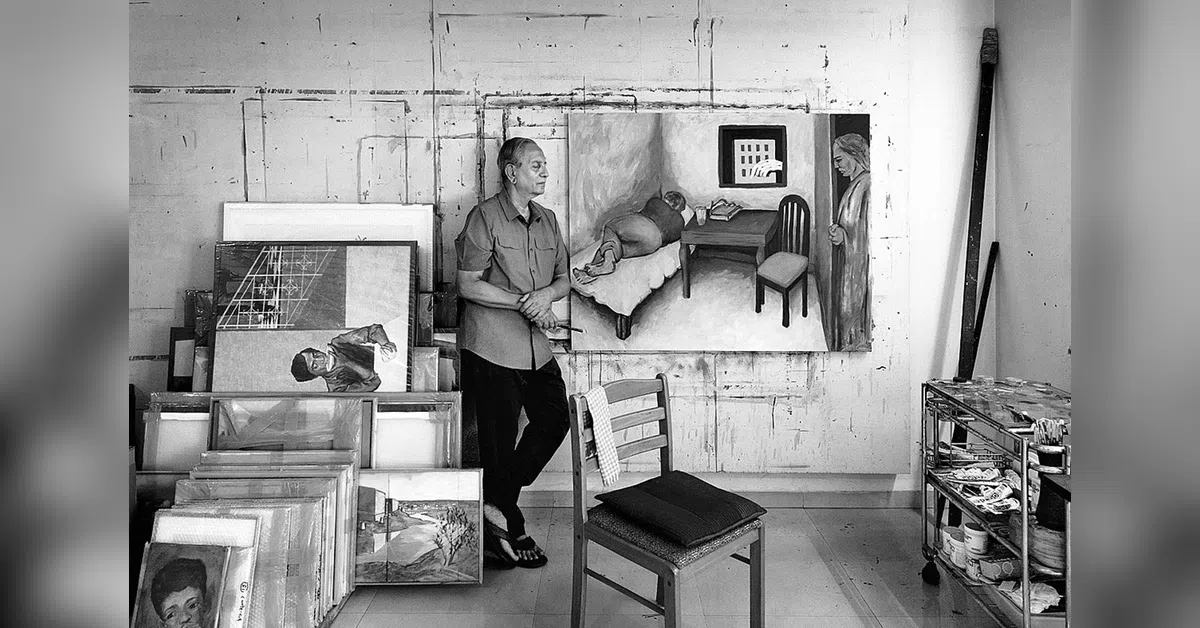
Chawla’s photographs are visual essays in themselves; Striking because the artists come across as workers with tools in hand rather than celebrity posers enjoying wine and cheese. He said, “The studio is a sacred space where peace, solitude and movement coexist. It is also a forbidding ascetic zone where creation is a struggle and excitement.” For this reason alone, this book is of immense archival value. Unlike AI, human artists don’t work like machines because they build from life experience, and frustration is part of the process.
However, there is a danger in talking about the studio in mystical and overly sentimental terms. Artists don’t do everything on their own. They rely on the labor of curators, assistants, interns, interns, writers, catalogers, installers, publicists, cleaners, cooks, and unpaid spouses.
Studios can also turn into sites of violence, as the sexual harassment allegations that emerged during the MeToo movement have shown. When the studio is elevated to a shrine, it is easy to forget that, for many, it is a workplace without adequate redressal systems such as internal grievance committees. In an industry where access to resources is concentrated in the hands of a few, there is limited room for people without generational wealth and social capital.
While reading this book, it is difficult not to think about the cost of accommodation in art centers like Delhi, Mumbai, Kolkata, Bengaluru and Chennai. The question of who can afford studio rent in addition to a home demands serious consideration because grants and fellowships, which are difficult to get, rarely cover rent. A large number of professional artists have to make peace with financial uncertainty, find a kingmaker, or supplement their windfall income with assignments they never put on their resumes. This is the bitter reality of the art market.
The reviewer is a Mumbai-based freelance journalist; @chintanlekhan on Instagram and X
a studio tour
Inside the Creative Sanctuary
derive from an artist’s illustration By Rohit Chawla, text by Kishore Singh, with permission from Mappin Publishing and KNMA
Ghulam Mohammad Shaikh
Apart from books, his (Ghulam Mohammad Sheikh’s) paintings and his studio are his world. “In a sense, the studio is a home within a home. Whenever I return from outside, I don’t feel like I’ve arrived home until I enter the studio.” This, his sanctum, is where he can be found most of the time, whether painting, drawing, surrounded by his sketchbooks, or writing. “I have two walls for painting and a third wall that is designated for watching movies using a movie projector.”
Third love – music – The artiste starts with the couple doing morning exercises and follows them to the studio where he listens to classical Indian singing, folk, devotional, Sufi and sometimes western music, with Kumar Gandharva and Siddheshwari Devi being his favourites.
I will never forget seeing Jayshree Burman stretched out on a large table, resting on her stomach, filling in the details of a painting – a process so difficult that she suffers from chronic back pain. That’s when I met him at his house in New Delhi. Her studio – called her official studio – is in Okhla, a building she shares with her artist husband, Paresh Maity, where one floor is her dedicated workspace.
This is not unusual, it has a table that divides the room into two horizontal halves. Here I sit as she pulls drawers open to let you into the intimate spaces of her practice: paintings in which figure is absent, are abstract, or involve mediums that include sand and cowry shells. For a moment it seems as if the silt of the Hooghly and the waves of the Bay of Bengal have flowed inland into New Delhi.
Burman’s art celebrates her own purity. An oil lamp is lit on the home altar and the air is scented with incense; There are fresh flowers, and the sound of conch shells to purify the air around him. But the studio is also his sacred space, a place ruled by the goddess Saraswati, so Burman has to appease her before he can begin work. It is a ritual that calms and heals him, and makes him whole. In the studio, sipping a coffee next to her, she will sketch for two to three hours, part of her rigorous practice.
Burman has a female world in which men and gods balance harmony and provide support to women and goddesses and their families. She is invested in their womanhood, yet this aspect does not take away from the inherent feminism: women are goddesses, nurturers, mothers, providers. “They give me energy,” says Jayshree. “I talk to my paintings, I’m a crazy person.”
Leaning over her painted goddess-scenes with enchanted gardens and ponds with swans, Jayashree creates her own magical world, investing the imagination with the hope of reality, a world she imagines amid the early morning temple bells and the auspicious sound of the evening. Anything is possible in that time, because the artist is at work.
A spiritual loner, preferring solitude over fellowship, Mithu Sen draws on terms like resistance, rebellion and subversion to explore subversion in her art practice. Violence of any kind becomes a trigger for her – personally as well as professionally – and she draws her art from that same violence “so something beautiful comes out of it.” She abhors pity or sympathy, challenges majoritarian viewpoints and bristles at the mention of politics. When asked why her actions are dark, she casually says, “Maybe I’m a witch,” because I see evil.
But Mithu is far from evil, she attaches herself to people or relationships because she responds instinctively to genuineness, kindness, thoughtfulness. But he is also able to objectively separate himself from any kind of attachment. “What is home?” she asks. “I don’t know what home means. I never miss home. I create my own reality and live in it.”
In his studio in Surajkund, he has created open rooms that lead from one to the other, with windows that offer views of what was once a forest. Here she works from dawn to dusk and often later, sometimes working from her bunk bed because it is easier than going home. “I take my studio with me wherever I go, because if you’re willing to throw yourself into the unknown, your body becomes your home,” she says of her frequent travels.
Vikrant Bhise wears his Dalit identity on his sleeve, having overcome his liabilities through education, a change he sees all around him, which he wants to document by providing a glimpse of how lives and homes are changing as Ambedkarites are abandoning the slave mentality, often accompanied by resistance and opposition. His art serves to remind us that 75 years after Ambedkar’s Constitution shaped a new vision for India, change is still slow but inevitable.
Vikrant’s own background is the stuff of mainstream fairy tales, but it was not without its struggles – he worked as a courier before starting to delve into the rarefied world of art. “The Ambedkarite movement depended heavily on Dalit literature, Dalit poetry and Dalit food,” something that is a subject of ongoing research for him, given that it also forms the subject of his often deeply touching paintings. “I want to show how the community is growing and changing, turning it into canvas as a visual artist. I have simplified my visual expression so that common people everywhere can understand it. My work addresses all forms of protest and rebellion, not just Dalits, and I make it so that people everywhere can relate to it.”
Portrait of an Artist by Rohit Chawla, excerpted from text by Kishore Singh, with permission from Mappin Publishing and KNMA