Marc Faber estimates a 20% decline in these
Have the markets completely written off the possibility of a resolution to the West Asia war?
Global stock markets are not one market. There are many markets in different countries and industries. Some stocks are highly valued, especially in the United States (US). Anything related to artificial intelligence (AI) and semiconductors is ‘sky in the sky’ and earnings estimates are very high and, in my view, unrealistic.
Typically, in an investment bubble or mania, earnings are overestimated. Sooner or later, earnings start to disappoint and stocks adjust very rapidly to the downside.
It is difficult to find really cheap stocks at present. An example would be Indonesian stocks. After being weak for a long time, they have declined by 30 percent this year. I think their pricing is reasonable, but I don’t think their price will go up much in the near future.
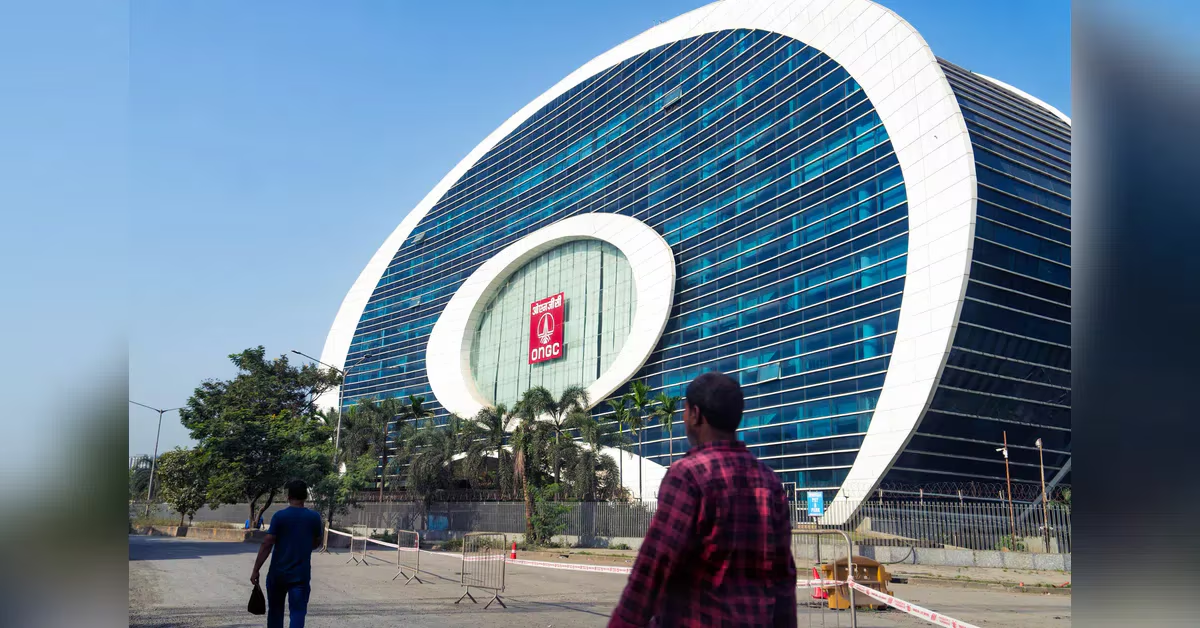
I believe India has started a bear market and we will still go down. This has nothing to do with the economy. The economy is doing well, but the stock market is not cheap enough for me to buy. He said, Indian markets are cheaper than before in 2024 because the markets have gone down. Since then the rupee-dollar equation has also changed. But for me, Indian markets are not cheap enough for me to start buying. I think Indian markets can go down another 20 percent from here.
What could be the main reasons for the decline in Indian markets?
I think earnings will start disappointing and that will impact market sentiment. We also need to know that markets nowadays are driven by global liquidity, which is still increasing, but at a slower pace than before. All this will impact the Indian stock markets in future.
How are global financial markets reacting to developments in West Asia?
Asian markets are fine. Some are very speculative and high, such as South Korea and Taiwan. But they are not all driven by stocks. Instead, they are driven by a handful of stocks.
The Korean market is driven by two or three stocks that make up more than half the market capitalization – SK Hynix and Samsung Electronics. The same is true for Taiwan. Taiwan Semiconductor is by far the largest company.
So if you look at the index, it doesn’t tell you what the common stock is doing. It tells you what technology stocks, AI-related stocks, and semiconductor stocks are doing.
How do you see global central banks responding to this situation?
Of course, they will try to print money and they can do that. As you know, in the US they started cutting short-term rates in October 2024. What happened to the bond market and long term rates? They went upstairs.
The US Fed and other central banks have limited power. They could cut interest rates and ease monetary conditions and perhaps stocks would rise. But in my opinion, in inflation-adjusted terms they will go down. It is like the Indian market. In dollar terms it is much lower than the rupee.
What is your opinion on gold, silver and crude oil?
I am fundamentally positive about precious metals. We had a strong rally from 2024 to early 2026. Now we are in the recovery phase and, in my view, this recovery phase is not over yet. We are still likely to go further down. In the long term, I think people should own some precious metals.
On crude oil, I don’t think it is that expensive at present. A huge step was taken in this and then it was rectified. The solution to the Iran conflict is very complex and will take time. In my view, oil prices will go up rather than go down.
What would be your advice to investors in the current times?
At a time when everyone wants to speculate and everyone thinks that the value of their property, stock or asset will increase, my advice is to keep some cash with you. What people don’t realize is that the markets—including real estate, stocks, collectibles, and fine wines—are highly insecure. If they go low, they may go very low.
So, do you expect a decline in most asset classes in the next six months?
It could be six months, nine months or three months. But at the present time, I think the downside risk is greater than the upside potential.
Which markets may remain relatively untouched or fall lower?
Some markets have already bottomed out a lot and may remain in better shape than others. But it would be wrong to think that if America goes down by 30 or 50 percent then the market will go up. As a precaution, investors should hold unusually large positions in cash and possibly bonds. I have a bond portfolio because it may not be a good investment, but it may be a better investment than a stock portfolio that is down 30 percent.
Are we ready for a K-shaped return, where developed markets – and those that own artificial intelligence (AI)-related stocks – gain at the expense of emerging markets?
In a bubble, it is very difficult to point to a stock and say today is the top. If I look at AI-related stocks and semiconductors and the largest market-cap stocks in the US like Nvidia, Apple and Microsoft, generally – and there may be exceptions – but generally, as happened in 1929, in 1973, with oil stocks in 1980, with technology stocks in 2000 and with home builders and subprime lenders in 2007, and 1989. Even in Japan, when the most popular field was at its peak. Outside, the most popular stocks fell by at least 70 percent afterward.
If you buy Nvidia or Micron today, the stock might go up another 20 percent. It is possible. But they will decline a lot later on and that’s a risk I don’t want to take. Some people think they will buy a stock and sell it before it drops. Usually these people lose a lot of money because they forget to sell or the sales are unexpected.
What are your thoughts on a potential SpaceX IPO and listing?
I have no idea other than that the valuation is too high. Those are not bargain valuations that would make me interested in investing in that company.