
US court bans Trump’s bid for E
By Zoe Tillman
A US appeals court rejected the Justice Department’s request to let federal officials proceed fully with Donald Trump’s overhaul of mail voting ahead of the November midterm elections, upholding a Boston judge’s order that declared the president’s policies unlawful.
The three-judge appellate panel said it would not block a lower court ruling that blocked federal agencies from immediately enforcing Trump’s executive order in nearly two dozen states and the District of Columbia where Democratic officials had sued.
Several other legal challenges against the president’s directive are pending, including a lawsuit brought by the Democratic National Committee and party leaders in Congress.
The Justice Department had previously indicated in court filings that it would consider taking the fight to the US Supreme Court. While the Boston judge’s injunction does not apply nationwide, it is considered a significant hindrance to the administration’s ability to enforce Trump’s executive order for the November vote.
Lawyers from all political parties are racing to win their election-related legal battle ahead of November, when Republicans will defend a tight margin of control over both houses of Congress.
A majority panel of the U.S. Court of Appeals for the First Circuit found that at this early stage of the case, the suing states presented sufficient evidence that they were being harmed by the President’s actions and had standing to press their claims.
“All told, amid compressed timelines and anticipated changes to states’ election processes, the summary judgment record indicates that the EO has already created ‘incredible pressure’ on state election officials and their teams,” Judges Gustavo Gelpi and Julie Rickelman wrote in a joint opinion referring to Trump’s executive order. Both judges were appointed by former President Joe Biden.
Judge Joshua Dunlap, appointed during Trump’s second term, dissented in part, writing that he would have allowed a section of the challenged order, which directs the Department of Homeland Security to compile a list of potentially eligible US citizen voters as guidance for states running the election.
Spokespeople for the California Attorney General’s Office, which led the coalition of states that sued, and spokespeople for the Justice Department and the White House did not respond to requests for comment. A dozen Republican state attorneys general also intervened in the case in support of the president’s order.
The government argued that the Homeland Security list was intended only to serve as a resource for local jurisdictions. The state officials who filed the lawsuit pointed to language in the executive order that threatened criminal prosecution if they did not use the federal lists to determine who is eligible to vote.
Postal Service
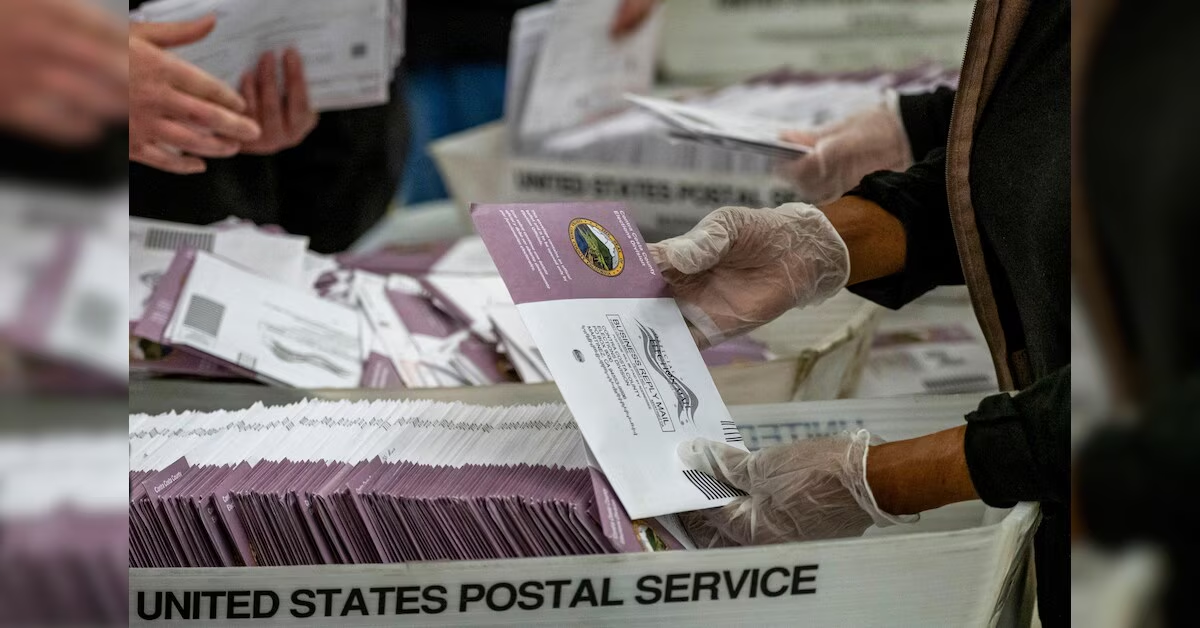
The President also ordered the U.S. Postal Service to reform the design of election mail and adopt rules that would require states to coordinate with the agency on lists of residents ready to receive mail-in ballots. The suing states argued that it would illegally turn the Postal Service into an “election regulator” and give the agency the power to refuse to deliver ballots.
The administration and supporters of the president are promoting these measures as safeguards against fraud. Democrats, voting rights organizations and others condemned the plan, calling it an unlawful move to interfere with state management of congressional elections and create chaos and confusion that has already been created to benefit Republicans.
In late June, a judge in Boston sided with Democratic state officials who sued, declaring several sections of Trump’s order “unconstitutionally void” and blocking agencies from executing it in those jurisdictions before the November 3 election.
In the DNC case in Washington, a federal district judge entered an order in May refusing to block the executive action before the November contest, finding that it was premature because the agencies had not taken steps to enforce it. Shortly after that decision, the Postal Service began the formal rulemaking process.
Democratic officials involved in that case have asked the D.C. Circuit to stop and block Trump’s directive before the Nov. 3 midterms.
The case is California v. Trump, 26-1774, U.S. Court of Appeals, 1st Circuit.