


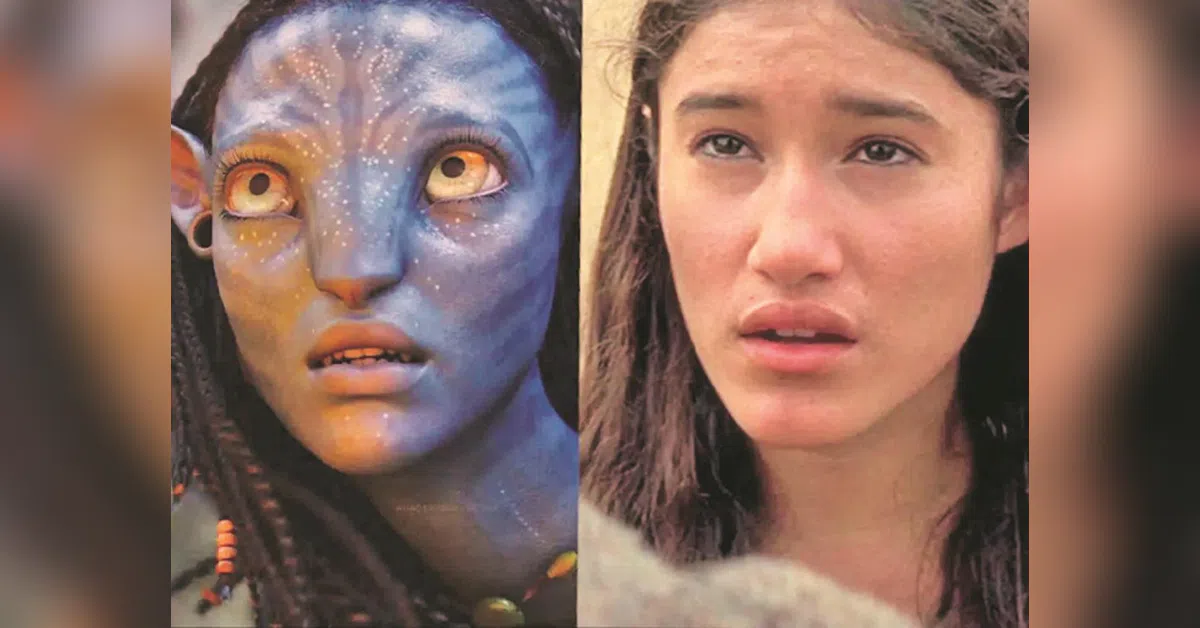
An actress accuses director James Cameron of stealing her likeness to create the “Avatar” character in a lawsuit filed Tuesday in California — a case that reflects a core fear among Hollywood actors of artificial intelligence.
The Age of Intelligence: Losing Control of Our Own Faces.
The actress, Cuorinka Kilcher, also sued Disney, which controls the billion-dollar “Avatar” franchise that began in 2009.
“In the age of AI, our equality is no longer secure,” Kilcher, 36, said in an interview. “Although what happened to me is personal, it is also a huge warning that, if we don’t act now, this type of thing will become the norm. This case is about the future of identity.”
The lawsuit involves Neytiri, the digitally created, blue-skinned warrior princess in Cameron’s three “Avatar” blockbusters. According to the complaint, Cameron used a photo of Kilcher from her teenage years – without her knowledge – as the foundation for Neytiri, incorporating her features “directly into his production art” and into the digital production pipeline.
“Neytiri’s lips, chin, jaw, and overall mouth shape in the trilogy” are those of Cuorinka Kilcher, the complaint states. “This was no fleeting inspiration or vague homage; it was a literal transplant of an actual teenager’s facial structure.”
According to the complaint, in 2010, Kilcher, who is also an indigenous rights activist, met Cameron by chance at a charity event in Hollywood, where she told her that she was the “initial inspiration” for Neytiri’s look. “He did not imply that his real face had been replicated,” the complaint said.
Kilcher is now suing because Cameron gave an interview to a French media outlet in 2024, the complaint says. In the interview, Cameron mentions Kilcher and “points to an image of Neytiri and clearly says: ‘This is actually her lower face,'” the complaint states. He learned of the interview a year later.
“For the first time in a public forum, Cameron candidly admitted the entire truth about Neytiri’s design,” according to the complaint, which was filed in the U.S. District Court for the Central District of California in Los Angeles. “One of Hollywood’s most powerful filmmakers exploited a young Indigenous girl’s biometric identity and cultural heritage to create a record-breaking film franchise, without crediting or compensating her.”
A lawyer for Cameroon did not respond to a request for comment. Disney had no immediate comment.
Kilcher’s action is the latest in a large number of legal attacks on “Avatar” over the past few years — nearly all of them settled by courts in Cameron’s favor, including five separate lawsuits alleging copyright infringement or theft of ideas. The sixth violation lawsuit is ongoing and was expanded last month.
In part, Kilcher is suing under California’s decades-old “right of publicity” statute, which allows people to bring claims against unauthorized use of their identity. It’s a complex area of law that has taken on a new urgency in the age of generative AI, an emerging technology that allows anyone with an Internet connection to easily create images that replicate existing art, photographs, and human likenesses.
Generally speaking, right of publicity laws (about 25 states have one) balance First Amendment protections by distinguishing between commercial exploitation (using a likeness to sell a product) and expressive works (e.g. news, art, parody). But “there’s not always a bright line,” said Jennifer E. Rothman, a professor at the University of Pennsylvania’s Cary Law School, who is seen as a leading authority on privacy rights law.
Kilcher’s break in Hollywood came in 2005, when, at the age of 14, she was cast as Pocahontas in Terrence Malick’s “The New World”. She has since starred in films such as “Dogs” and TV shows such as “Yellowstone,” and is a member of the Academy of Motion Picture Arts and Sciences.
Kilcher is seeking damages that include “all profits” made due to the unauthorized use, including sales of “Avatar” tickets; The three “Avatar” films have collected $1.8 billion at the North American box office alone.
“The damages we are seeking are commensurate with exploitation,” Arnold P. Peter, one of Kilcher’s lawyers, said in an interview.