
Israeli border town Dravi
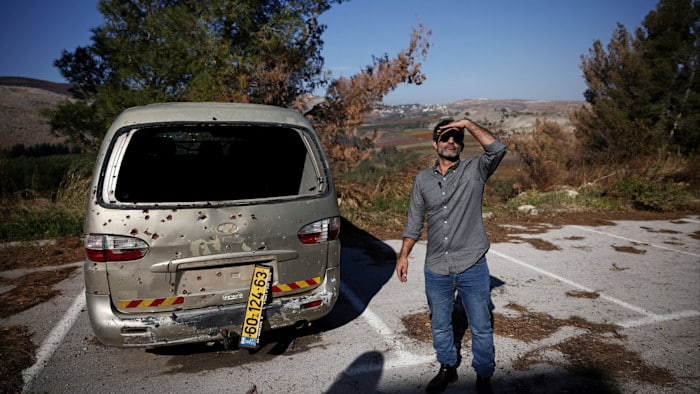
Israel’s response to Hezbollah’s rocket attacks in 2023 was to evacuate its northern border cities. This time the math has changed: It is keeping residents in their place and instead taking the fight deeper into Lebanon.
Ravit Ben Ami, one of the thousands evacuated last fall, lives in a kibbutz so close to Lebanon that she has only seconds to hide when sirens warning of incoming missiles or drones go off. But when Hezbollah resumed hostilities this month, he decided to remain in Hagoshrim, with the blessing of his government.
During a break between her shifts as a social worker she said, “We live from one siren to another… but this is my home, and no one can throw me out of it again.” “I think it was a mistake to kick us out last time.”
Benjamin Netanyahu’s government appears to have reached the same conclusion. At some political cost, it ordered more than 60,000 people from their homes in 2023 – many of whom had only returned last year when Israel and Hezbollah agreed to a US-brokered ceasefire in 2024.
But when the Iran-backed Lebanese militant group joined the war effort and began firing on Israel again this month, the Israeli government sent thousands of troops across the border to set up a buffer zone.
There were no evacuation orders in Israel, but more than 1 million Lebanese people have been forced from their homes. Analysts say the operation, which has killed more than 1,000 people, could also be a prelude to a much larger attack on Hezbollah.

The decision is partly a reflection of the hyper-aggressive military doctrine Israel adopted following the failures that allowed Hamas’s October 7, 2023 attack. It has seized land and imposed buffer zones from Gaza to Syria, deploying massive forces against opponents across the Middle East.
But it is also indicative of how the security situation in Israel and the government’s strategic calculations have evolved over the past two years.
In 2023, Israeli officials feared that Hezbollah militants could attack northern communities in the same manner as Hamas did in the south and assessed that the Lebanese terrorist group had a stockpile of more than 100,000 missiles that it could deploy.
But during the year of war that followed, Israel launched heavy attacks on Hezbollah, destroying its leadership, pushing its fighters back from the border and destroying a significant portion of its infrastructure. Although the group still has significant supplies of drones and missiles, analysts estimate that at least two-thirds of its arsenal has been destroyed.
“So far they are mainly using ordinary missiles… 122 mm missiles, which are basically artillery rockets,” said Ariel Frish, a security official in Kiryat Shmona, a town just 2 km from the Lebanese border that was heavily targeted by Hezbollah in 2023-24 with a mix of armed drones, anti-tank guided missiles and Flak 1 and Burkan weapons.
“Maybe Hezbollah is being weakened, maybe Iron Dome is being improved. I don’t know. It’s too early to draw conclusions.”
Iran is now firing ballistic missiles at all of Israel, killing 15 people so far, Frisch said, adding that there are also fewer benefits to moving people away from the North than there were two years ago. “Israel is being attacked by Iranian missiles from north to south,” he said. “There is nowhere to run.”

According to Frisch, the population of kibbutzim such as Hagoshrim has largely returned to its pre-war levels, but the picture is bleaker in larger cities such as Kiryat Shmona, where about 40 percent of the population has not returned.
Some consider the 2023 withdrawal tantamount to moving Israel’s border southward and argue that another round of departures would be a strategic gift to Hezbollah.
“Hezbollah’s only achievement of the first period [in 2023] The decision to evacuate us was the Israeli government’s,” said Nisan Zeevi, a resident of Kibbutz Kfar Giladi, less than 2 km from the border, who founded an organization dedicated to bringing people back to the north.
“We are glad the government learned this lesson.”
Netanyahu and his allies have not yet said how far they intend to extend the buffer zone into southern Lebanon, which is designed to buttress Israel’s decision not to evacuate northern towns and villages, where many residents are angry at finding themselves under fire again barely a year after officials claimed Israel had defeated Hezbollah.
Zeevi said the minimum required to protect border communities is to move the Israeli military beyond the range of anti-tank missiles, which are particularly difficult to intercept because of their flat trajectory. This, he said, would mean creating a buffer zone stretching at least 8 km in Lebanon.
But Israeli officials are also considering far more expansive options, according to three people familiar with the discussions, including advancing north to the Litani River and even deploying troops into the Bekaa Valley, parts of which are considered Hezbollah strongholds.

A person briefed on the talks said Israel had been working on planning a campaign against Hezbollah even before the US-Israeli attack on Iran, and some officials saw Hezbollah’s decision to enter the war in support of Iran as an opportunity for Israel to eliminate the terrorist group.
“Israel faces two fronts [in Iran and Lebanon]. It’s a very challenging situation,” said Yaakov Amidror, who served as Netanyahu’s national security adviser and is now a fellow at the Jinsa think-tank in Washington. “The program may be different because we need to continue attacking Iran. But in principle, the answer is yes: [Israel should finish Hizbollah]”
But Israeli officials are also using the threat of a broader attack to pressure the Lebanese government to disarm Hezbollah, something Israeli officials have claimed they are unable or unwilling to do. Lebanese officials are hesitant for fear of igniting more civil conflict.
An Israeli official said, “Now is an excellent opportunity for the Lebanese government to disarm Hezbollah because now that the Ayatollahs’ regime is under siege like never before, Iran will no longer be able to finance their proxies.” “Hezbollah is losing its gravy train.”

Either way, analysts said Netanyahu would like a breakthrough before Israel holds parliamentary elections later this year.
Nadav Shtroukler, a political adviser who previously worked with Netanyahu, said he expected the prime minister to launch a ground offensive in Lebanon.
But he said it was possible that this could eventually lead to some kind of political agreement with Lebanon.
“Netanyahu cannot go to the polls… because the threat still remains,” he said. “It should be a different situation than it is now.”
Mapping by Janina Conboy