Financial development: role of
The Ethiopia-Djibouti corridor is at the center of this transformation, serving as Ethiopia’s primary gateway for import and export flows.
For financial institutions like IibGroup, the role of banking extends far beyond liquidity provision. It is about deploying capital to support economic resilience, strengthen the business ecosystem and deliver measurable social and environmental impact.
establishing stability at scale
Unlike traditional ESG approaches, which operate as standalone initiatives, IIB East Africa integrates sustainability directly into its core financing model. By 2025, more than 80% of the bank’s loan portfolio was aligned with ESG-related financing, reflecting a deliberate shift towards impact-driven banking.
This represents a 20% increase in ESG-aligned financing from January 2025, driven by growth in renewable energy, infrastructure financing and trade finance solutions for ESG-compliant businesses. This scale of integration positions IIB as the leading ESG-focused financial institution in Djibouti.
Supporting business through ESG-aligned finance
Trade finance remains central to East Africa’s economy, yet many SMEs in essential sectors face limited access to structured financing.
IIB East Africa has expanded its dedicated trade finance facilities for ESG-compliant SMEs, particularly those involved in food import/export and essential commodities. These facilities support regional food security, responsible supply chains and cross-border trade flexibility.
By linking trade finance with ESG principles, the Bank ensures that capital supports not only commercial growth, but also macroeconomic stability and sustainability.
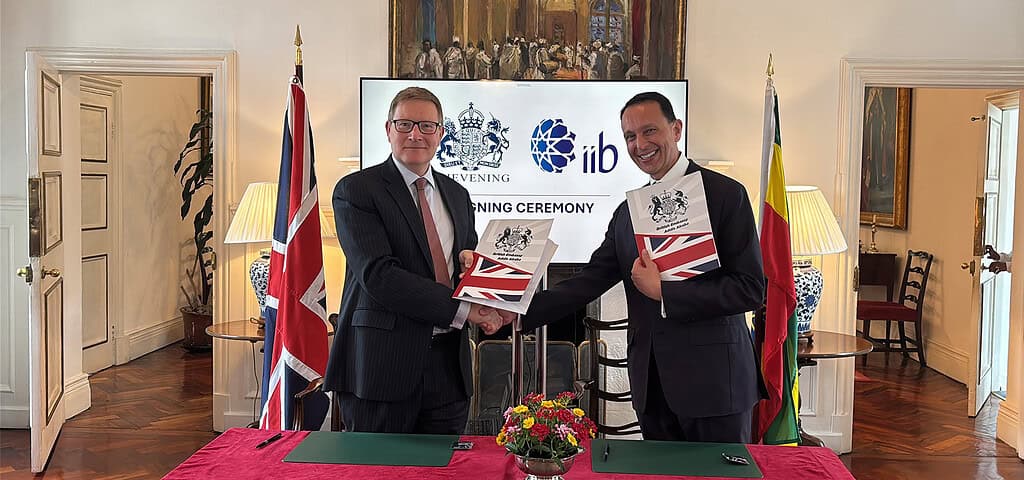
His Excellency Darren Welch, UK Ambassador to Ethiopia and Permanent Representative of the African Union to Ethiopia, and Sohail Sultan, Chairman of the IIBGroup, at the signing ceremony of the Chevening Scholarship Partnership in Addis Ababa.
Raising capital for high impact projects
Beyond trade finance, the IIB is raising capital largely through structured sustainable finance initiatives.
A significant development is a pipeline of approximately US$72.5 million, which includes a planned US$30 million social bond programme, a US$25 million green bond and a US$17.5 million blue carbon programme.
The social bond program is designed to finance high-impact projects including affordable housing, regional food security, telecommunications, essential infrastructure for education and health care, and capital for ESG-aligned SMEs.
Green bonds will improve the energy efficiency of industrial and logistics SMEs.
Meanwhile, the Blue Carbon Program will restore 1,675 hectares of mangroves, conserve an additional 780 hectares, install 400 hectares of protective green barrier and aim to sequester 2 million tonnes of CO₂. And with an estimated investment of US$17.5 million and an expected IRR of over 20%, it demonstrates how sustainable finance can generate both commercial returns and measurable environmental outcomes.
expansion into ethiopia
By establishing a representative office in Addis Ababa, iibGroup has taken an important step in expanding this model to one of Africa’s largest and most promising markets.
This expansion supports the IIB’s strategy to serve as a regional financial intermediary, facilitating cross-border trade, investment and capital flows between East Africa and international markets.
Supported by a strong correspondent banking network of over 30 relationships in Ethiopia and the wider region, the Bank provides trade finance, structured trading, cross-border payments, foreign exchange settlement, liquidity management and risk participation solutions.
Through its presence in Djibouti and Ethiopia, the IIB is positioned to connect local businesses with international capital while supporting trade, infrastructure and private sector development in the corridor, strengthening its role as a regional connector.
Scaling social impact beyond financing
In frontier markets, sustainable finance extends beyond balance sheet activity. IIB East Africa complements its financing activities with direct community engagement that promotes inclusive development.
In 2025, this includes:
- Food distribution initiative targeting vulnerable communities.
- Literacy programs and education assistance.
- Environmental campaigns including beach cleanups and tree planting.
- Health awareness initiatives including breast cancer awareness programme.
Additionally, the Bank is financing a housing project in partnership with Qatar Charity, which includes the construction of 79 homes, as well as a mosque and Islamic educational centre, representing a total investment of approximately US$500,000.
These initiatives reinforce the principle that sustainable finance should create both institutional and community impact.
A Model for Sustainable Banking in Marginal Markets
As East Africa’s financial systems evolve, banks are becoming active promoters of economic growth rather than mere financial intermediaries.
IIBGroup’s approach – based on ESG integration, trade facilitation and capital raising – demonstrates how sustainable banking can be effectively implemented in marginalized markets. By aligning financial performance with measurable impact, the Bank is contributing to the development of a more resilient, inclusive and interconnected regional economy. With the Ethiopia-Djibouti corridor, this model is not only relevant; This is necessary.