West Asia War: Plastic Factory
Like many others in the Ganeshwarpur industrial area, Ratan Singh has also been unemployed for 15 days.
Spread over an area of approximately 70 acres, Ganeshwarpur is one of the seven main industrial estates and development centers in the coastal district, with plastics, polymers and allied clusters. About 20 micro small and medium enterprises (MSME) units here produce polypropylene-based household products, bags, pipes and fittings.
The impact of the West Asia War is visible on the factories in the industrial sector. The number of workers employed in this estate has come down from 1,500 on normal days to less than 800 now.
“How long can we work like this? If the war continues for another week my children will die of hunger,” says Ravindra Sahu, sitting idle at a tea stall near his factory waiting for a call to come back.
Inside Jagadamba Polymers Ltd, a plastic household goods manufacturing unit in the center of the industrial cluster, injection molding machines have stopped one after another. Half-finished stacks of bath sets, casseroles, baby products and planters, once rolled in bulk, remain scattered near idle conveyor belts.
Rajendra Mandal, an employee at Jagadamba, which operates the largest injection molding plant in Odisha, fears losing his job. “We never thought this factory would face this kind of situation,” Mondal says, gluing a jug on a production line.
Factory managers admit that contract workers are the first casualties when production slows down. Production in-charge Karthik Chandra Kar says, “Production has reduced by about 70 percent. Out of 10 production lines under one shed, only two are running.” He explains that the machines are being recalibrated as per the demand as the products should not pile up when the cost of raw materials is so high.
As the tax says, uncertainty is more frightening than the immediate loss of income.
India, while having a significant domestic petrochemical production capacity, depends heavily on crude oil imports to meet the growing demand for polymers.
When global supply chains are disrupted, manufacturers in India face both price shocks and supply shortages. Chandra Prakash Bhartia, Managing Director of Jagadamba Polymers Limited, explains that the Indian plastics processing industry is extremely sensitive to global crude oil movements. “Polymers are directly linked to naphtha and other crude oil derivatives,” he says. “When there is geopolitical instability, prices go up.”
According to Bhartia, the prices of polymers and PET resins have increased by 75 percent. “We have no option but to reduce production.”
Production fell in every sector
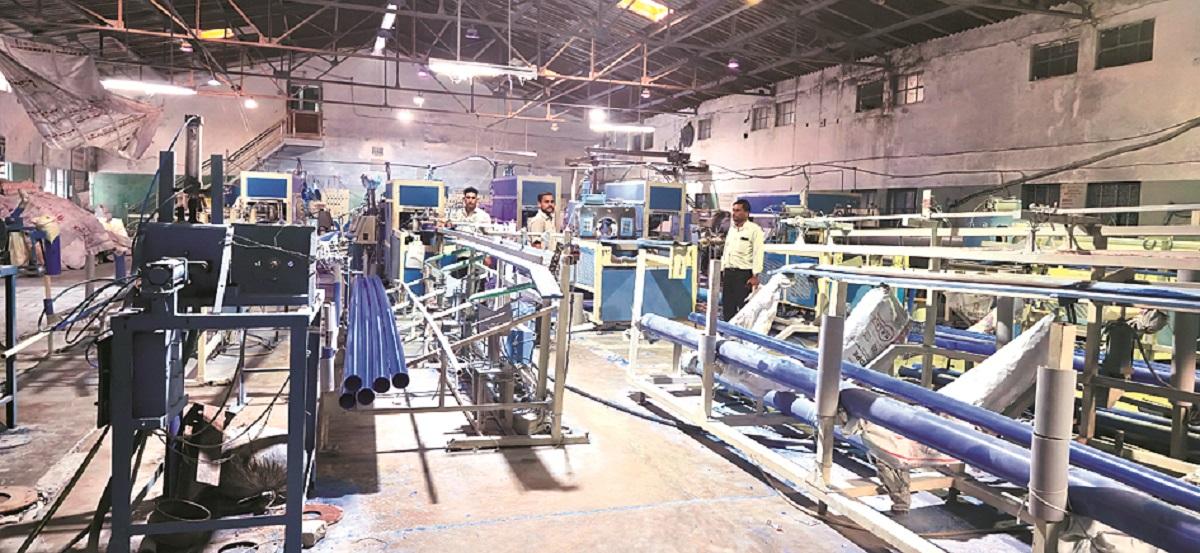
A few kilometers away, inside Hari Plast, a plastic pipe and fittings manufacturing unit, the scale of the disruption is even greater. Long extrusion lines, which once ran continuously, are now idle. Of the 12 lines with an installed monthly capacity of 650 tonnes of polyvinyl chloride (PVC), chlorinated polyvinyl chloride (CPVC), high-density polyethylene (HDPE) and medium-density polyethylene (MDPE) pipes, only two are operational, producing limited quantities of pipes for irrigation, drinking water and infrastructure projects.
“The factory typically produces more than 300 types of pipes and fittings,” Tarun Ray, vice-president (technical), Hari Plast, tells Business Standard. Now it has come down to just 10-12 types.” Only about 60 employees are now at work, compared to more than 350 in three shifts during normal days.
At Neo Tubes in Ganeshwarpur, managing director Sovendra Prasad Dash walks through his facility, pointing to idle machines. “We have five extrusion lines,” he says; Now only one is running. A month ago, we produced around 100 tonnes per month; Now it has reduced to less than 20 tonnes.
Some units are completely closed. Nikunj Chhotrai, Managing Director of Valentina Pipes Private Limited, says that his factory has been closed for several days. “There is no clarity on pricing or supply,” he explains.
Even companies with more capacity and better financial buffers have reduced production by 50 to 70 percent. “We have rationalized production to reduce losses,” says PK Dave, chief operating officer, Kolkata-headquartered Ori Plast. We have slightly increased the product prices, but the demand has also fallen,” said Ori Plast, which has an installed capacity of 1,200 tonnes per month at its Balasore facility.
Why are plastic units affected?
Plastic products are made from a range of raw materials starting with crude oil and natural gas, making the industry highly sensitive to global energy markets. At a base level, crude oil is refined to produce naphtha, while natural gas produces ethane and propane. These feedstocks are processed in petrochemical plants to generate key building blocks such as ethylene and propylene.
These products are then converted into polymers such as HDPE, LLDPE, PP, PVC and PET resins, which are used by plastics manufacturers to make everything from pipes and containers to furniture and packaging. In addition, a variety of additives such as plasticizers, stabilizers, pigments and fillers are also used to give plastics their desired strength, flexibility, color and durability.
India’s dependence on imported petrochemical inputs compounds the problem. HDPE prices rose from around Rs 91,452 per tonne on February 28 to Rs 1.6 lakh by April 1 (75 per cent), followed by LLDPE – from Rs 90,952 to around Rs 1.61 lakh (77 per cent) and PVC – from Rs 89,000 to Rs 1.16 lakh (30 per cent).
Since raw materials account for about 70 per cent of the total cost of plastic products, such a sharp increase has a direct and serious impact on manufacturers. Most micro, small and medium enterprises operate on low margins and long-term supply contracts, making it difficult to pass on the burden of sudden cost increases to customers.
Big ecosystem in danger
The impact on production has been rapid and severe. This has become a double blow for plastic pipe and fitting manufacturers, who were already grappling with weak demand even before the rise in raw material prices. The sharp rise in polymer costs comes at a time when government-led demand, one of the biggest drivers of the sector, has declined significantly.
The budgetary allocation for FY26 under the Jal Jeevan Mission, a flagship program that boosts demand for HDPE and PVC pipes used in rural water supply projects, has been drastically reduced from the initial estimate of Rs 67,000 crore to a revised estimate of Rs 17,000 crore due to slow spending, delay in implementation and reports of irregularities in the project, forcing the government to withhold the funds for review.
For units like Hari Plast and Om Pipes, which are heavily dependent on government contracts for large-scale pipe supplies, the shortfall in allocation has already led to cancellation of contracts and delays in payments. “Earlier Jal Jeevan Mission had ensured stable demand throughout the year,” quips a manufacturer. That shortage has now ended.
In Odisha alone, there has been a huge decline in production in 56 units dealing with plastic products. Industry associations estimate that more than 40 per cent of plastic products manufacturing units (small units) have closed down, while the remaining medium and large units have drastically cut down operations.
Summarizing the situation, Sangram Das, president of Odisha Plastic Pipes Manufacturers Association, says things have reached breaking point.