Prime Minister inaugurates Noida Airport
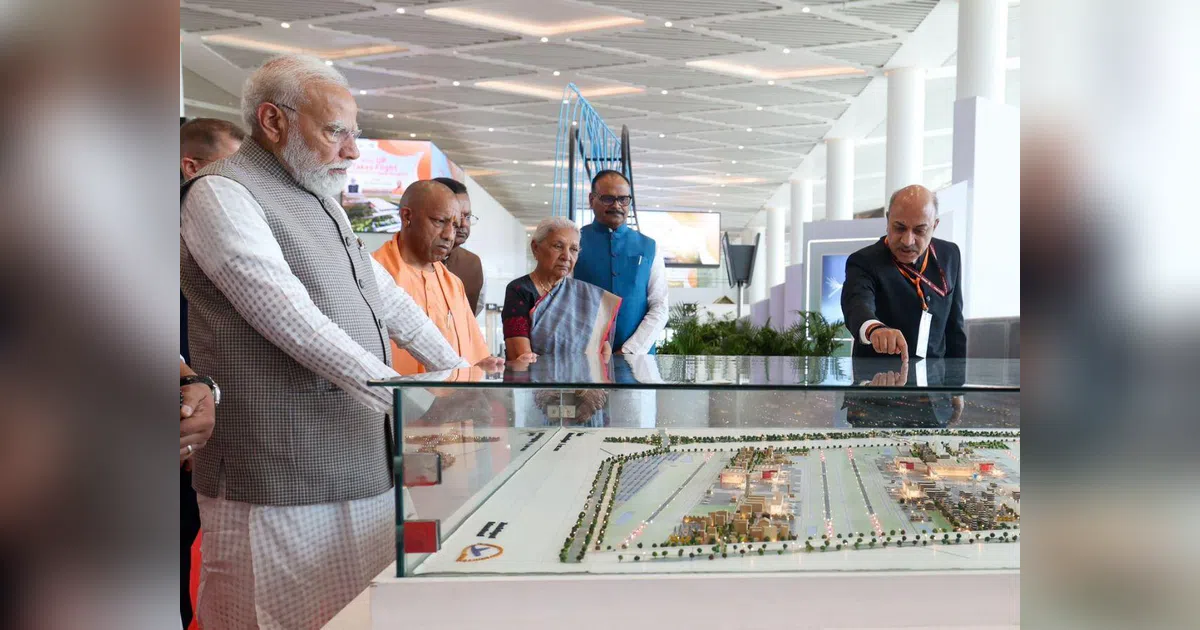
Prime Minister Narendra Modi on Saturday inaugurated the Noida International Airport, saying the facility will serve as a major growth driver for western Uttar Pradesh while underscoring the government’s effort to expand aviation infrastructure, boost domestic maintenance capabilities and protect the economy from global disruptions.
In an unconventional gesture, Modi asked people present at the venue to turn on the flashlights of their mobile phones for the symbolic inauguration of the airport, and said, “This is your property, this is your future…It is also being inaugurated by your hands.”
The Prime Minister pitched Jewar airport as a major connectivity and economic hub for cities including Agra, Meerut, Aligarh, Ghaziabad and Mathura, and said it will open new opportunities for farmers, small industries and youth in the region. He said, “Planes will fly from here to all over the world and at the same time it will also become a symbol of the flight of developed Uttar Pradesh.”
Highlighting the capacity, Modi said the airport was being built to handle higher traffic, adding that “a plane will take off every two minutes”. He linked the project to broader infrastructure development in the region, including a semiconductor facility in Noida and the Namo Bharat corridor as well as the expansion of the Meerut Metro.
The airport is being developed by Yamuna International Airport Private Limited (YIAPL), a wholly owned subsidiary of Zurich Airport International AG, under a public-private partnership model with the Government of Uttar Pradesh and the Central Government. The concession period for the project began on October 1, 2021 and will run for 40 years.
In terms of infrastructure, the airport is being developed in phases. The first phase consists of a terminal building with an area of approximately 138,000 square meters and a runway of 3,900 metres, with an estimated passenger handling capacity of 12 million per annum. The second phase is expected to expand the capacity to 30 million passengers annually. A second terminal and runway will be added in subsequent phases, bringing total passenger capacity to 70 million per annum, cargo handling capacity to around 1.5 million tonnes and aircraft parking capacity to around 200.
Referring to the BJP governments at the Center and the state, Modi said, “These projects are a grand example of the double engine government’s efforts for the development of UP.”
Modi also used the occasion to draw out political contradictions, noting that the airport project was approved in 2003 under former Prime Minister Atal Bihari Vajpayee but did not progress for years. He said, “From 2004 to 2014, this airport remained buried in the files.” He said that the work gained momentum only after the BJP came to power both at the Center and in Uttar Pradesh.
The main focus of the speech was the government’s plans to strengthen India’s aviation ecosystem, especially maintenance, repair and overhaul (MRO) capabilities. Modi said that currently “85 per cent of the aircraft in India have to be sent abroad” for MRO services. He announced that an MRO facility is being developed in Jewar, which will service both domestic and foreign aircraft.
He said, “When this facility is ready, it will provide service to domestic and foreign airlines… the country will also earn money, our money will also stay in the country and the youth will also get a lot of jobs.”
Highlighting the expansion of India’s aviation network, the Prime Minister said the number of airports has increased from 74 before 2014 to over 160 now. He also mentioned the expansion of the regional connectivity scheme UDAN, noting that the government has sanctioned about ₹29,000 crore for its next phase, which plans to develop 100 new airports and 200 helipads.
Modi said, “As new airports are being built in India, the need for new aircraft is also increasing.” He said Indian airlines have placed orders for hundreds of aircraft, which will create demand for skilled manpower in aviation services.
Modi also linked the airport development to broader logistics and supply chain reforms, pointing to the convergence of dedicated freight corridors in Dadri. He said that with better multimodal connectivity, agricultural products and industrial goods of the region will be able to reach global markets faster.
On the macroeconomic front, the Prime Minister noted the ongoing geopolitical tensions in West Asia, noting that the conflict has disrupted the supply of essential commodities such as fuel, fertilizers and food items. “India is bringing huge quantities of crude oil and gas from places where the war is going on,” he said, adding that the government is taking steps to ensure that the burden does not fall on ordinary families and farmers.
He also highlighted the role of ethanol blending in reducing import dependence, adding that increasing ethanol production from sugarcane has helped in cutting crude oil imports and saving foreign exchange. According to him, without ethanol blending, India would have had to import “45 crore barrels…about 700 crore liters of crude oil” annually.
Modi said the government has significantly increased spending on infrastructure, including investment in highways, railways, ports and waterways, over the past decade to support economic growth. He said better connectivity, including projects like NaMo Bharat Corridor, has reduced travel time and increased mobility in the region.
Calling for unity amid global uncertainties, Modi urged political parties to avoid statements that could harm national interests. He said, “Whatever is in the interest of India…that is the policy and strategy of the Government of India.”
The Prime Minister also thanked the farmers who donated land for the airport project and said their participation will help usher in a new phase of development in the region.