
How did MBS’s bet on Iran backfire?
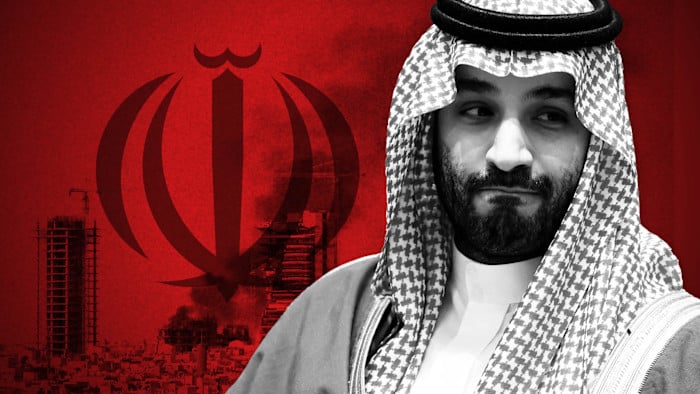
In the space of a few years, Saudi Crown Prince Mohammed bin Salman went from warning against “appeasement” of Iran’s supreme leader Ayatollah Ali Khamenei – the “new Hitler of the Middle East” – to initiating a historic disengagement with Tehran.
In one of his signature foreign policy moves, Prince Mohammed worked to defuse years of animosity between his Sunni kingdom and the Shia theocracy, betting that engagement was the best way to create the regional stability needed for his ambitious economic vision.
Their worst fears have now been realized. Since the US and Israel attacked Iran two weeks ago, the Islamic regime has repeatedly attacked Saudi Arabia and its Gulf neighbours, targeting US bases in the kingdom, the US Embassy in Riyadh, the giant Ras Tanura refinery and its vast Shayba oil field.
“This is the last thing he wanted. He wants stability and order, he doesn’t want missiles and drones flying around,” said Bernard Heckel, a professor of Near Eastern studies at Princeton University who speaks to Prince Mohammed. “He didn’t want that at all.”

The longer the war lasts, the more threatened the prince’s campaign to attract foreign investors to support his megaprojects and present the kingdom as a trade, tourism and finance hub. Formula 1 has already canceled its April races in Saudi Arabia and Bahrain because of the war.
So far the kingdom has not been hit as badly as other Gulf states such as the United Arab Emirates, Bahrain and Qatar, which have endured more attacks from Iranian missiles and drones. Access to the Red Sea also means it can bypass the Strait of Hormuz, the strategic waterway that has been virtually closed due to Iranian attacks, and ship goods and crude oil.
“Obviously we remain vigilant, but the noise needs to calm down to get a better understanding of what’s going on here,” a Saudi official said. “It’s pretty much business as usual.”
Still, Amin Nasser, chief executive of state-owned energy giant Saudi Aramco, underlined Riyadh’s concerns last week, warning of “disastrous consequences” for the world economy if the war prolongs. “This is the biggest crisis the region’s oil and gas industry has ever faced,” he said.
Firas Maqsad, managing director of the Middle East and North Africa at Eurasia Group, said the conflict was a blow to Prince Mohammed’s Vision 2030 plan to transform the kingdom’s economy and attract foreign direct investment. “They were already missing their target,” he said. “Now they have to focus on other things as well. They have to refocus spending on defense. It’s going to be a very long timeline.”

Analysts say there are few good results for Saudi Arabia or other Gulf countries.
Publicly, Saudi Arabia has condemned Iran and called for de-escalation. Yet Gulf leaders are now torn between a desire to end the conflict and a fear that – if US President Donald Trump suddenly halts his invasion – the war will leave a wounded, bolder and more radical Islamic regime in their backyard.
A person familiar with Riyadh’s thinking said Saudi Arabia did not want regime change in Iran but was in the interests of a weak republican state. “There’s a value to what’s happening, but to what extent do you want to say: ‘Let’s not stop now. Just give it another push’,” the person said. “You don’t want to go into no man’s land.”
Although Gulf countries had previously worked to prevent war, Maksad said some now want Trump to “finish the job” – even if “what that means is a completely different question”.
“Some people are wary of anarchy,” he said. “But what it means for everyone is that Iran’s ability to fire missiles and drones at them will be significantly reduced, so at the very least Iran’s capability will be further reduced.” A Saudi official denied to Al Arabiya a report that Prince Mohammed has encouraged Trump to continue attacking Iran.

Saudi Arabia and other Gulf states have been wary of the threat posed by Iran to the region since the 1979 Islamic Revolution and view it as a malign force throughout the Middle East. But Riyadh restored diplomatic ties with Iran in 2023 in a Chinese-brokered deal to ease tensions after a seven-year hiatus.
The pair maintained regular lines of communication – the crown prince’s brother, Defense Minister Prince Khalid bin Salman, met then-supreme leader Khamenei in Tehran last year – during two years of regional conflict triggered by Hamas’ October 7, 2023 attack on Israel.
As tensions between the US and Iran have risen in recent months, Prince Mohammed sought to keep the kingdom out of any conflict, telling Iranian President Massoud Pezeshkian in January that Riyadh would not allow its airspace or territory to be used for military action.

It was to no avail, as the Islamic Republic, in what it sees as a fight for survival, attacked the Gulf states as part of a strategy designed to increase costs for the US and its allies.
“Prince Mohammed was hoping against hope that Saudi Arabia would not be attacked,” Heckel said. “The Iranians also signaled to them that, ‘If we are threatened existentially this will be a scorched-earth policy, we will burn the entire area to the ground making the Americans pay a very heavy price.’ And that’s exactly what they’re doing.”
Heckel said Riyadh was in talks with nuclear-armed Pakistan, with which it signed a mutual defense pact in September, and China, the main buyer of Saudi and Iranian oil, to pressure Tehran into reducing tensions with the kingdom.
Saudi Arabia’s Prince Sultan Air Base in al-Kharj, which hosts US forces, has regularly been the target of Iranian fire, killing one US soldier. Two foreign workers have also been killed in the attacks.
The attacks have sparked speculation about whether Riyadh might eventually open its airspace to US offensive operations, or even become involved in the conflict if there was a major attack on its oil facilities — such as when half of the kingdom’s crude oil production was temporarily knocked out in 2019 in response to a missile and drone attack on Iran.
There was still communication between Riyadh and Tehran, but through ambassadors rather than at high levels, a person familiar with the matter said. “The illusion that good working relations can be developed with Iran is gone,” the person said.
The Trump administration and Israel were also angry at Saudi Arabia’s involvement in the war, the person said, and Gulf countries warned there would be serious consequences for the region.
“There is frustration over the fact that basically the United States is not only here to liberate the Gulf countries from the effects of their war, but they are doing just that.” [Israeli Prime Minister Benjamin] Netanyahu’s war,” said Aziz Alghasian, a lecturer in international relations at Riyadh’s Naif Arab University for Security Sciences.

The person familiar with the matter said Riyadh was “not unhappy” with US defense support, adding that the kingdom was receiving US missile interceptors “to the extent possible” given high demand from other Gulf states and Israel.
Washington and Riyadh signed a defense deal when Trump hosted Prince Mohammed at the White House in November.
Yet, despite cordial relations between the two leaders, which span the US president’s first term, the conflict has underlined Riyadh’s reasons to be wary of Trump’s transactional style and unpredictability.
“They all knew he was a transactional, unpredictable person,” Heckel said. “Are they happy with it, no? But what can they do? He’s the American president.”
Satellite image visualization by Aditi Bhandari, data visualization by Alan Smith and cartography by Alyssa Honra