Divine Lifestyle
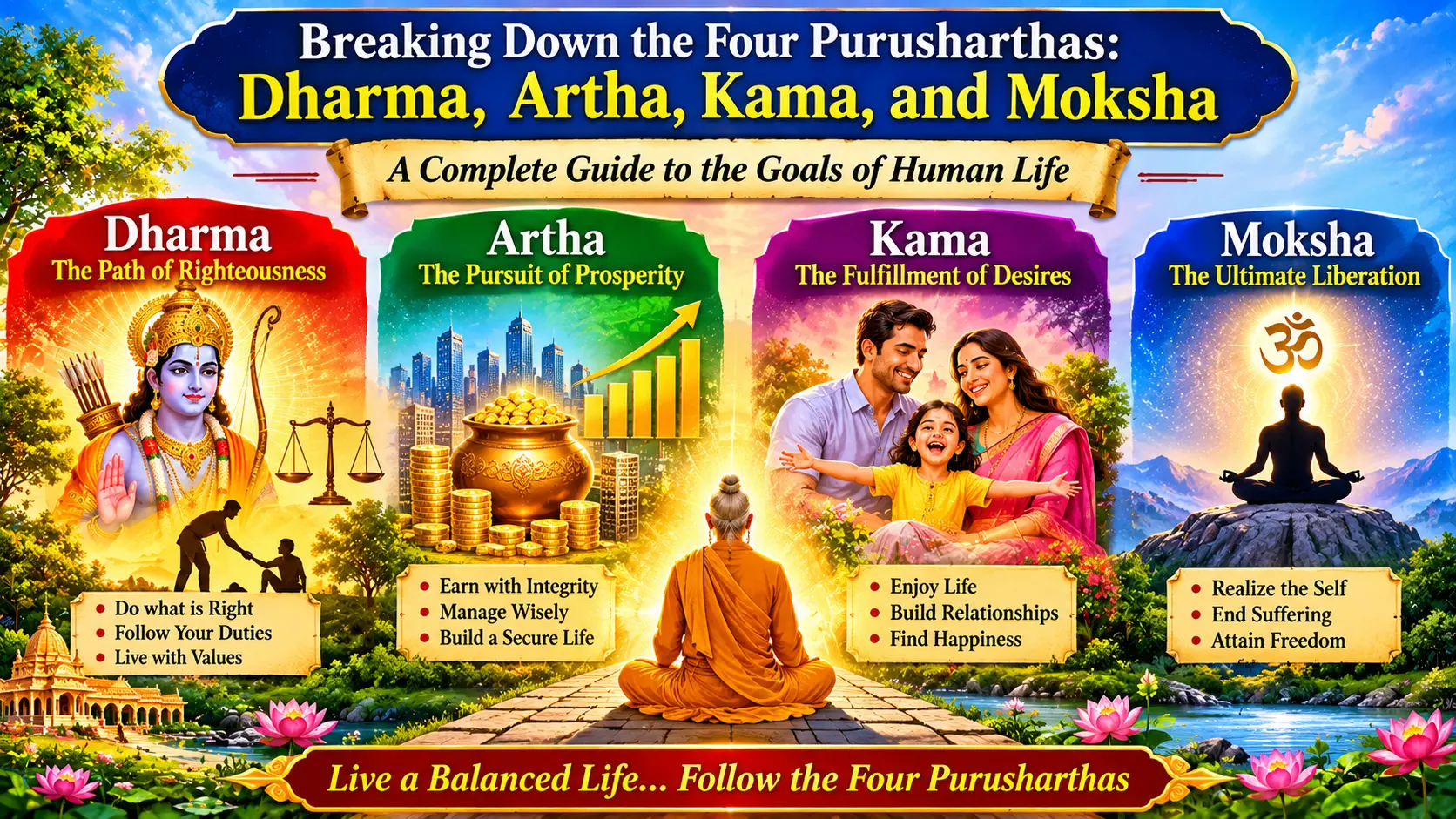
Breaking Down the Four Purusharthas: Dharma, Artha, Kama, and Moksha – The Four Pillars of a Meaningful Life
Table of Contents
Introduction
What is the true purpose of human life? Is it to earn money, build a successful career, enjoy relationships, fulfil personal desires, or attain spiritual liberation? Different people may have different answers, but ancient Indian philosophy offers a remarkable framework that brings all these aspects together.
According to Hindu philosophy, human life has four fundamental objectives known as the Four Purusharthas: Dharma, Artha, Kama, and Moksha. The Sanskrit word Purushartha means the purpose, objective, or meaningful pursuit of human existence.
These four principles provide a balanced approach to living. They explain how a person should fulfil responsibilities, earn wealth, experience happiness, and ultimately seek freedom from the cycle of birth and death.
Rather than asking us to reject worldly life, the concept of Purusharthas teaches us how to live responsibly in the world while maintaining a connection with our spiritual nature.
Let us understand these four pillars and discover how they can guide our everyday decisions.
1. Dharma: The Foundation of Righteous Living
Dharma is the first and perhaps the most important Purushartha. It represents righteousness, moral responsibility, duty, truth, justice, and the principles that maintain harmony in individual and social life.
Dharma is much more than following religious rituals or traditions. It is about understanding what is right and performing our responsibilities honestly.
For example, a teacher’s Dharma is to educate students sincerely. A doctor’s Dharma is to treat patients with dedication. A parent’s Dharma is to nurture and guide children. A businessperson’s Dharma is to conduct business honestly and fairly.
In every situation, Dharma encourages us to choose the right path, even when doing so may be difficult.
How Dharma Influences Everyday Life
Imagine that a businessperson has an opportunity to earn substantial profits through dishonest practices. Although the decision may bring immediate financial benefits, it could harm customers and damage the trust of society.
Following Dharma means rejecting such practices and choosing honesty over temporary gains.
Dharma teaches us:
- Speak the truth and maintain honesty.
- Respect parents, teachers, elders, and fellow human beings.
- Fulfil personal and professional responsibilities.
- Avoid harming others for selfish benefits.
- Treat people with fairness and compassion.
- Protect nature and respect all living beings.
Why Is Dharma Important?
Without Dharma, wealth and pleasure can become sources of greed, exploitation, and suffering. Dharma provides the moral direction needed to pursue other goals responsibly.
It acts like a compass that guides our decisions and keeps our actions aligned with higher values.
2. Artha: The Importance of Wealth and Material Prosperity
Artha is the second Purushartha. It refers to wealth, financial security, resources, professional success, and material prosperity.
Hindu philosophy recognises that money and material resources are essential for a comfortable and stable life. A person needs food, shelter, education, healthcare, and financial security to fulfil personal and family responsibilities.
Therefore, earning wealth is not considered wrong. In fact, pursuing prosperity through honest and responsible means is an important part of human life.
How Artha Influences Everyday Life
Consider a young person who studies hard, develops professional skills, builds a career, and works towards financial independence.
By earning money honestly, this individual can support family members, provide education to children, help people in need, and contribute to society.
This is the positive expression of Artha.
However, problems arise when wealth becomes the only objective of life.
People sometimes sacrifice health, relationships, honesty, and peace of mind in the endless pursuit of money. Artha should support life, not control it.
Principles of Responsible Artha
- Earn wealth through honest and ethical activities.
- Develop skills and work with dedication.
- Save and invest responsibly.
- Avoid greed, corruption, and exploitation.
- Support family members and dependants.
- Contribute to social welfare through charity and service.
- Maintain a balance between earning and enjoying life.
Why Is Artha Important?
Without financial stability, fulfilling many personal and social responsibilities becomes difficult.
Artha provides the resources necessary to practise Dharma, enjoy life, and create opportunities for future generations.
The important lesson is that wealth should be earned through Dharma and used for meaningful purposes.
3. Kama: The Pursuit of Happiness, Love, and Desires
Kama is the third Purushartha. It represents desires, love, pleasure, emotional satisfaction, beauty, relationships, and enjoyment of life.
Human beings naturally seek happiness. We enjoy music, art, friendship, family relationships, travel, entertainment, and the experience of love.
Hindu philosophy does not consider all desires negative. Instead, it recognises that happiness and enjoyment are natural dimensions of human existence.
However, Kama must be guided by Dharma.
How Kama Influences Everyday Life
Consider a person who works hard throughout the week and spends weekends with family, enjoys music, visits beautiful places, and develops meaningful relationships.
These experiences provide emotional satisfaction and make life enjoyable.
Similarly, love between partners, affection for children, friendship, artistic expression, and appreciation of nature are different expressions of Kama.
The difficulty begins when desires become uncontrolled.
For example, excessive attachment to possessions, unhealthy relationships, addiction, jealousy, or the constant need for pleasure can disturb mental peace.
How to Pursue Kama in a Balanced Way
- Develop loving and respectful relationships.
- Appreciate art, music, culture, and nature.
- Enjoy food and entertainment responsibly.
- Respect the feelings and boundaries of others.
- Avoid excessive attachment to material pleasures.
- Practise gratitude for what you already have.
- Balance personal desires with responsibilities.
Why Is Kama Important?
Life without love, happiness, emotional connection, and enjoyment can become incomplete.
Kama reminds us that human life is not only about duties and financial achievements. It is also about experiencing beauty, affection, companionship, and meaningful happiness.
The key is to enjoy life without becoming controlled by desires.
4. Moksha: The Ultimate Goal of Spiritual Liberation
Moksha is the fourth and highest Purushartha in Hindu philosophy. It represents liberation from the cycle of birth, death, and rebirth, known as Samsara.
According to Hindu spiritual traditions, human beings are not merely physical bodies or temporary identities. Their deepest nature is associated with the Atman, or the eternal Self.
Moksha is the realisation of this spiritual truth and freedom from ignorance, attachment, and bondage.
While Dharma, Artha, and Kama guide our worldly existence, Moksha represents the ultimate spiritual aspiration.
How Moksha Influences Everyday Life
Moksha does not necessarily mean abandoning family, work, or society and moving into a forest.
A person can pursue spiritual growth while fulfilling ordinary responsibilities.
For example, someone may work honestly, support their family, help others, and practise meditation without becoming excessively attached to success or failure.
Such a person gradually develops inner peace and a deeper understanding of life.
Paths Towards Moksha
Hindu philosophy describes several spiritual approaches:
1. Jnana Yoga – The Path of Knowledge
Jnana Yoga involves understanding the true nature of the Self through wisdom, self-inquiry, and spiritual knowledge.
2. Bhakti Yoga – The Path of Devotion
Bhakti Yoga encourages love, faith, surrender, and devotion towards God.
3. Karma Yoga – The Path of Selfless Action
Karma Yoga teaches us to perform our duties sincerely without excessive attachment to the results of our actions.
4. Dhyana Yoga – The Path of Meditation
Meditation helps calm the mind, develop awareness, and deepen spiritual understanding.
The Bhagavad Gita explains these spiritual approaches and provides guidance on attaining freedom through knowledge, devotion, disciplined action, and self-realisation.
Why Is Moksha Important?
Material achievements and worldly pleasures are temporary. Wealth may disappear, relationships may change, and physical beauty and strength eventually decline.
Moksha represents the search for something beyond these temporary experiences: eternal spiritual freedom.
It teaches us that lasting peace cannot depend entirely on external circumstances.
5. How the Four Purusharthas Work Together
The most beautiful aspect of the Four Purusharthas is that they are not four competing objectives. They are interconnected dimensions of a balanced human life.
Consider the following relationship:
| Purushartha | Main Purpose | Everyday Example |
|---|---|---|
| Dharma | Righteousness and duty | Living honestly and fulfilling responsibilities |
| Artha | Wealth and prosperity | Earning money through ethical work |
| Kama | Happiness and enjoyment | Love, relationships, and personal fulfilment |
| Moksha | Spiritual liberation | Meditation, self-realisation, and freedom from attachment |
Dharma provides the foundation for pursuing Artha and Kama responsibly. Artha provides the resources needed to fulfil duties and enjoy life. Kama brings happiness and emotional fulfilment. Moksha gives life its ultimate spiritual direction.
For example, a person who earns money honestly, supports their family, enjoys meaningful relationships, serves society, and develops spiritual awareness is attempting to balance all four Purusharthas.
This is the essence of a holistic life.
6. Practical Ways to Apply the Four Purusharthas in Modern Life
The ancient philosophy of Purusharthas remains relevant even in today’s fast-moving world.
You can incorporate these principles of Four Purusharthas into your daily routine:
For Dharma:
- Be honest in personal and professional dealings.
- Respect others and fulfil your responsibilities.
- Make decisions based on ethics rather than selfish interests.
For Artha:
- Develop professional skills.
- Work towards financial independence.
- Save, invest, and spend responsibly.
For Kama:
- Spend quality time with family and friends.
- Make time for hobbies and recreation.
- Appreciate the simple pleasures of life.
For Moksha:
- Practise daily meditation.
- Read spiritual literature such as the Bhagavad Gita.
- Develop detachment from unnecessary desires.
- Reflect on the deeper purpose of existence.
Even small changes can help create greater balance between material responsibilities and spiritual aspirations.
Conclusion: The Four Purusharthas – A Complete Philosophy of Life
The Four Purusharthas offer a timeless understanding of what makes human life meaningful.
Dharma teaches us how to live rightly. Artha teaches us how to earn and manage wealth. Kama reminds us to experience love, happiness, and pleasure. Moksha guides us towards spiritual liberation and the realisation of our true nature.
A life focused only on wealth may lack emotional satisfaction. A life focused only on pleasure may lack direction. A life without Dharma may lose its moral foundation. And a life without spiritual awareness may overlook its deeper purpose.
The real wisdom lies in balancing all four.
Earn through Dharma, enjoy through Kama, fulfil your responsibilities through Artha, and move towards Moksha through spiritual knowledge and self-realisation.
The Four Purusharthas remind us that the purpose of human life is not merely to survive, earn, and enjoy, but to grow into a wiser, more responsible, compassionate, and spiritually awakened human being.
That is the foundation of a truly meaningful life.
- Pingback: The Concept of Maya: Understanding Illusion in Hindu Philosophy