Divine Lifestyle
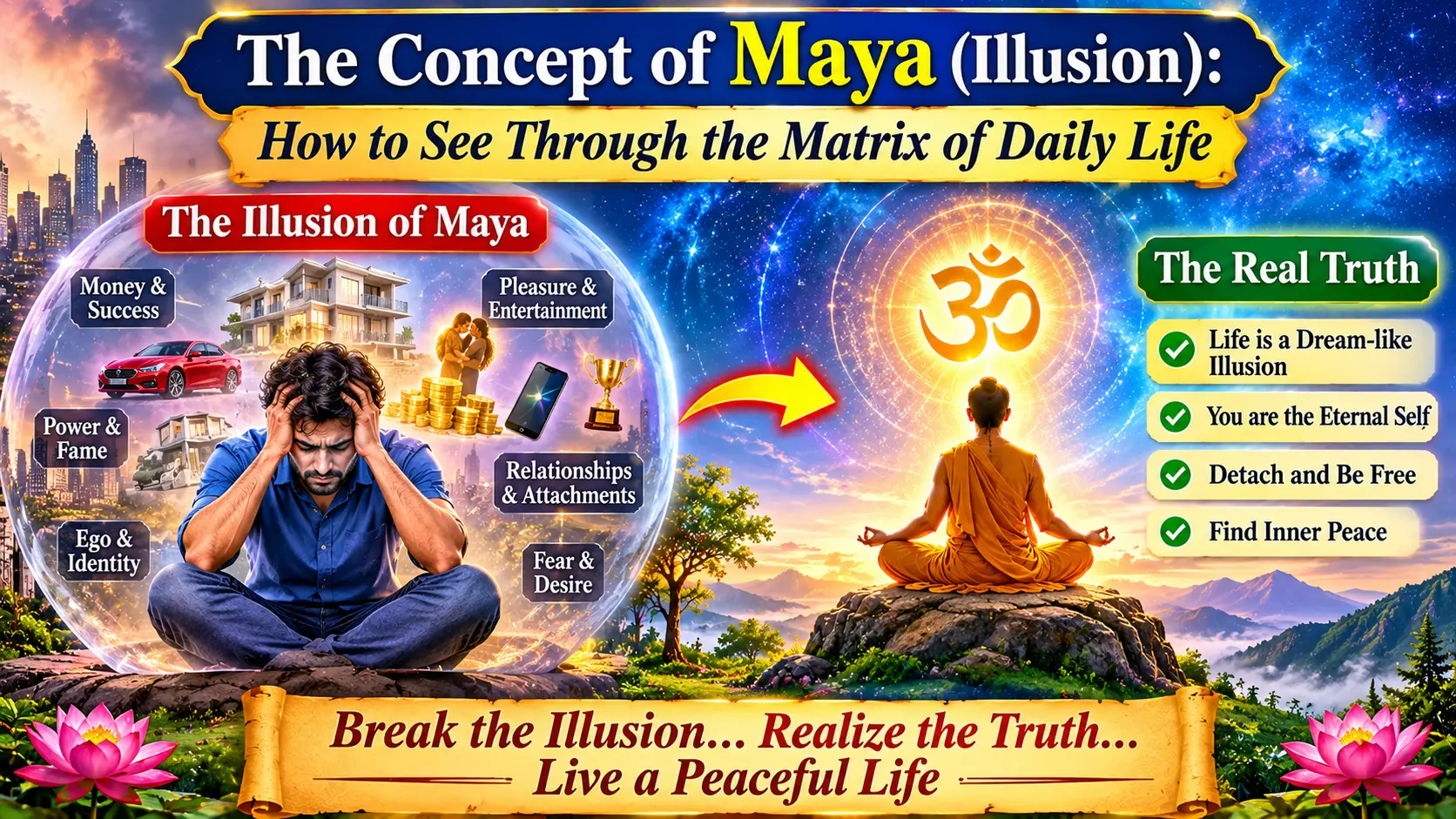
The Concept of Maya (Illusion): How to See Through the Matrix of Daily Life
Table of Contents
Introduction: Are We Living in Reality or an Illusion?
Have you ever wondered why people spend their entire lives chasing money, fame, beauty, relationships, and material possessions, only to realise that none of these things provides permanent happiness?
Why do we become emotionally disturbed when we lose something that we once considered essential? Why does success make us happy temporarily, while failure creates sadness and disappointment? And why do we sometimes mistake temporary experiences for permanent truths?
Ancient Indian philosophy offers a fascinating explanation for these questions through a syatem known as concept of Maya.
In Hindu philosophy, Maya is commonly understood as illusion, appearance, or the mysterious power through which the changing world is experienced as reality. It explains how human beings become attached to temporary things and forget their deeper spiritual nature.
The concept of Maya is especially important in Vedanta philosophy, where it helps explain the relationship between the physical world, the individual Self, and ultimate reality, known as Brahman.
Understanding Maya does not mean rejecting the world or believing that nothing exists. Instead, it means learning to distinguish between temporary appearances and the deeper truth behind existence.
Let us explore how Maya operates in everyday life and how we can develop the wisdom to see beyond it.
1. What Exactly Is Maya?
The Sanskrit word Maya is associated with the mysterious power of appearance, manifestation, and illusion.
According to Advaita Vedanta, the world of changing names and forms is experienced as reality, but it does not represent the ultimate, unchanging truth.
Brahman is described as the eternal and absolute reality, while Maya helps explain why the changing world and individual identities appear independently real.
A traditional example used to explain Maya is the rope and the snake.
Imagine walking along a dark road and seeing something lying on the ground. You believe it is a snake and immediately become frightened. Your heart starts beating faster, and you may even run away.
However, when someone shines a light, you discover that it was only a rope.
The rope was always there, but your lack of knowledge caused you to mistake it for something else.
Similarly, according to Vedantic thought, ignorance of ultimate reality makes us misunderstand the nature of existence.
We identify ourselves entirely with our bodies, thoughts, possessions, and social identities, forgetting the deeper nature of the Self.
This misunderstanding is one of the central aspects of Maya.
2. How Maya Controls Our Daily Life
Maya is not merely a philosophical idea. Its influence can be understood through ordinary human experiences.
A. The Illusion of Money and Wealth
Money is necessary for survival and provides financial security. However, many people gradually begin to believe that wealth is the ultimate source of happiness.
They spend their entire lives earning more money, purchasing expensive possessions, and comparing their financial status with others.
Even after achieving financial success, they may remain dissatisfied because their desires continue increasing.
The illusion lies in believing that external wealth can provide permanent inner satisfaction.
Money has practical value, but it cannot guarantee peace, love, wisdom, or freedom from fear.
B. The Illusion of Physical Beauty
Human beings often attach enormous importance to physical appearance.
We spend time and money trying to look younger, more attractive, and more impressive to others.
However, the physical body continuously changes. Childhood becomes adulthood, youth becomes old age, and physical beauty eventually fades.
Maya operates when we mistake the temporary body for our complete identity.
Hindu philosophy encourages us to understand that the body is an important instrument of life, but the deeper Self is not limited to physical appearance.
C. The Illusion of Relationships and Possessions
Love and relationships are valuable dimensions of human existence. However, suffering can arise when love becomes excessive attachment and possession.
We sometimes expect other people to behave exactly according to our wishes. When expectations are not fulfilled, we experience anger, jealousy, and disappointment.
Similarly, we become emotionally attached to houses, vehicles, property, and possessions.
The problem is not having relationships or material things. The problem is believing that they will remain unchanged forever or that our identity depends entirely on them.
Maya makes us forget the temporary nature of worldly circumstances.
D. The Illusion of Social Status and Recognition
Modern society places considerable importance on popularity, professional titles, social media followers, and public recognition.
People often measure their worth through likes, comments, achievements, and the opinions of others.
But social recognition is constantly changing.
A person who receives praise today may face criticism tomorrow. Someone admired by thousands may still experience loneliness.
When we depend entirely on external approval, we allow temporary opinions to control our inner peace.
Seeing through Maya means understanding that our deeper worth cannot be measured by social status.
3. Maya and the Bhagavad Gita
The Bhagavad Gita provides important insights into the nature of Maya.
In Chapter 7, Verse 14, Lord Krishna explains:
“Daivi hyesha gunamayi mama maya duratyaya; mam eva ye prapadyante mayam etam taranti te.”
Meaning: This divine Maya of Mine, consisting of the three Gunas, is difficult to overcome. However, those who surrender to Me can cross beyond it.
This verse explains that Maya is closely associated with the three Gunas: Sattva, Rajas, and Tamas.
- Sattva: Creates attachment to knowledge, happiness, and purity.
- Rajas: Creates attachment to desires, ambitions, and worldly achievements.
- Tamas: Creates ignorance, confusion, laziness, and delusion.
Even positive qualities can become limitations when we develop attachment to them.
The Bhagavad Gita teaches that freedom comes through spiritual understanding, devotion, disciplined action, and surrender to the Divine.
The objective is not simply to escape daily responsibilities but to perform them with wisdom and without excessive attachment.
4. Maya and the Modern Matrix of Life
The idea of Maya has an interesting connection with modern life.
Think about how much time people spend looking at mobile phones, social media platforms, advertisements, and digital entertainment.
We frequently compare our real lives with carefully selected images of other people’s lives.
Someone posts photographs of an expensive holiday, a new car, or a successful business. We may begin believing that their life is perfect while our own life is incomplete.
But what we see is only a small presentation of reality.
Behind the attractive photographs may be stress, financial pressure, personal struggles, and emotional difficulties.
This is a modern example of how appearances can influence our understanding of reality.
Similarly, advertising often creates artificial desires by convincing us that happiness depends on purchasing particular products.
We start believing that we need something new to become complete.
The digital world can therefore become another form of Maya when we lose awareness of the difference between appearance and reality.
The solution is not to abandon technology but to use it consciously.
5. The Difference Between Reality and Illusion
One of the most important lessons of Vedanta is learning to distinguish between temporary experiences and ultimate reality.
Consider the following examples:
| Temporary Appearance | Deeper Understanding |
|---|---|
| Physical beauty | The body continuously changes |
| Money and property | Material possessions are temporary |
| Praise and criticism | Other people’s opinions change |
| Success and failure | Both are changing experiences |
| Social identity | Identity is more than a name or profession |
| Happiness and sadness | Emotional states continuously change |
This does not mean that worldly experiences are meaningless.
They have practical importance and should be respected. However, we should not mistake them for permanent sources of happiness or the ultimate truth of existence.
In Advaita Vedanta, the distinction between empirical reality and absolute reality is particularly important.
The world is experienced and has practical significance, but Brahman alone is understood as the ultimate, unchanging reality.
6. How Can We See Through Maya?
Understanding Maya intellectually is only the beginning. The real transformation comes when we apply this wisdom in everyday life.
Here are seven practices that can help us develop greater awareness.
1. Practise Self-Inquiry
Ask yourself: Who am I beyond my name, profession, possessions, and physical body?
This question encourages deeper reflection on the nature of the Self.
2. Practise Meditation
Spend 10–20 minutes daily observing your thoughts and emotions.
Instead of reacting to every thought, learn to observe it calmly.
3. Reduce Excessive Attachment
Enjoy relationships, possessions, and achievements without making them the foundation of your entire identity.
4. Develop Discrimination (Viveka)
Viveka means the ability to distinguish between what is temporary and what is eternal, what is beneficial and what is harmful, and what is real and what merely appears real.
5. Practise Detachment (Vairagya)
Vairagya does not mean abandoning responsibilities. It means performing your duties without becoming excessively attached to outcomes.
6. Read Spiritual Literature
Study the Bhagavad Gita, Upanishads, and teachings of Vedanta. These texts encourage us to question our assumptions and understand the deeper dimensions of existence.
7. Develop Devotion and Gratitude
Prayer, devotion, and gratitude can help reduce ego, selfishness, and excessive dependence on material achievements.
7. Does Seeing Through Maya Mean Leaving the World?
Absolutely not.
A common misunderstanding is that spiritual awakening requires abandoning family, work, wealth, and social responsibilities.
However, the Bhagavad Gita teaches the importance of performing one’s duties while maintaining inner balance.
A person can be a responsible parent, successful professional, honest businessperson, and sincere spiritual seeker at the same time.
The important difference is the attitude with which life is lived.
Instead of believing that money defines your identity, understand it as a resource.
Instead of treating relationships as possessions, appreciate them with love and respect.
Instead of allowing success to create ego, remain humble and grateful.
Instead of becoming depressed by failure, learn from the experience.
This is how spiritual wisdom can transform ordinary living.
Conclusion: Wake Up from the Illusion and Discover the Truth
Maya is one of the most profound concepts in Hindu philosophy. It reminds us that human suffering often arises when we mistake temporary appearances for permanent reality.
We become attached to wealth, beauty, relationships, recognition, and worldly achievements because we believe they will provide lasting happiness.
But everything in the material world is subject to change.
The body changes, relationships evolve, possessions disappear, and circumstances never remain the same.
The wisdom of Vedanta encourages us to look beyond these changing experiences and discover the deeper reality of the Self.
The journey begins with awareness, continues through self-inquiry and spiritual discipline, and develops through knowledge, devotion, and detachment.
Remember: Maya does not necessarily mean that the world has no value. It means that we should not mistake the changing world for the ultimate truth.
When we learn to see beyond appearances, we begin to live with greater clarity, compassion, freedom, and inner peace.
That is the beginning of awakening from the matrix of daily life and moving towards the realisation of our true nature.