Unlike many major world religions, Hinduism has no single founder, single sacred book, or exact date of origin. Instead, it is the world’s oldest living religion—often referred to by practitioners as Sanatana Dharma (“the eternal order” or “eternal path”)—which evolved organically over more than 4,000 years on the Indian subcontinent through the blending of diverse cultural, philosophical, and spiritual traditions.
1. The Indus Valley Civilization (c. 3300 – 1300 BCE)
The earliest archaeological roots of Hindu culture trace back to the urbanized Indus Valley (Harappan) Civilization in northwestern South Asia. Excavations at sites like Mohenjo-daro and Harappa have uncovered several elements that later became central to Hinduism:
- Ritual Purity: Large public water structures, such as the Great Bath, suggest an early emphasis on ceremonial bathing and spiritual purification.
- Early Iconography: Stone seals depict figures seated in yogic postures surrounded by animals (often identified as “Pashupati,” an early prototype of Lord Shiva), alongside terracotta figurines representing the Mother Goddess (Shakti).
- Sacred Symbols: Early appearances of the swastika (an ancient symbol of auspiciousness) and reverence for sacred trees like the peepal.
2. The Vedic Period (c. 1500 – 500 BCE)
As Indo-Aryan pastoral communities settled in the Indo-Gangetic plain, their oral traditions merged with indigenous customs, giving rise to the Vedas—the foundational sacred texts of Hinduism (the Rigveda, Samaveda, Yajurveda, and Atharvaveda).
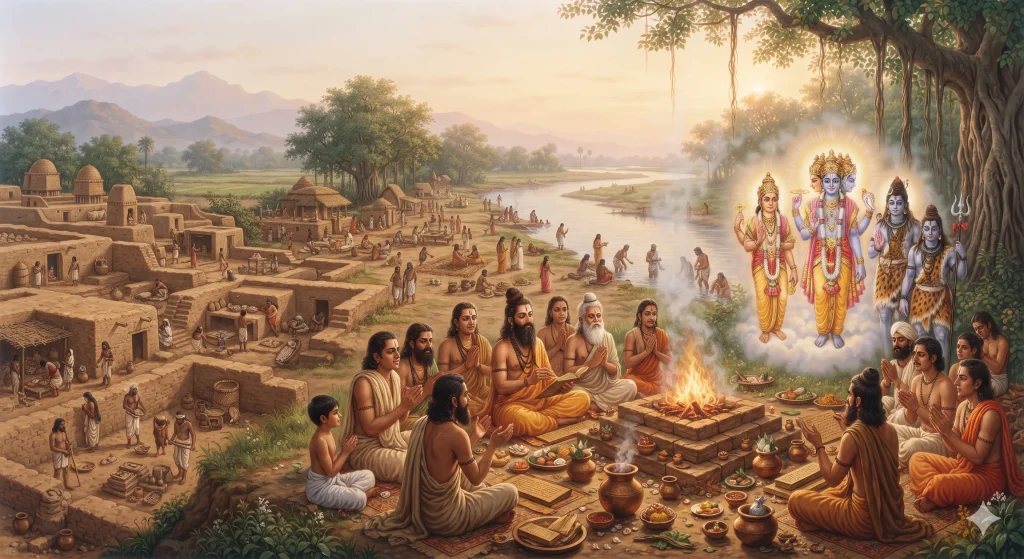
- Cosmic Order (Rta): Early Vedic religion centered on maintaining cosmic harmony through precise rituals, chanting of Sanskrit hymns, and fire sacrifices (Yajna) led by priests (Brahmins).
- Elemental Deities: Worship focused on natural and cosmic forces personified as deities, such as Agni (fire), Indra (thunder and rain), Surya (the sun), and Varuna (cosmic law).
3. The Upanishadic & Philosophical Shift (c. 800 – 200 BCE)
Toward the end of the Vedic era, spiritual thinkers shifted focus from external fire rituals to internal contemplation, producing the Upanishads. This period established the core metaphysical concepts that define Hindu philosophy today:
- Brahman and Atman: The realization that the ultimate, unchanging reality of the universe (Brahman) is identical to the individual soul (Atman).
- Karma, Samsara, and Moksha: The introduction of Samsara (the cycle of birth, death, and rebirth), governed by Karma (the law of moral cause and effect), with the ultimate goal of achieving Moksha (spiritual liberation from the cycle).
4. The Epic, Puranic, and Bhakti Synthesis (c. 500 BCE – 1000 CE)
In response to the rise of Buddhism and Jainism, Hinduism underwent a major synthesis that made spirituality accessible to everyone regardless of social standing:
- The Great Epics: Texts like the Ramayana and the Mahabharata (which contains the Bhagavad Gita) translated complex philosophy into relatable stories about duty (Dharma), devotion, and righteousness.
- Rise of Temple Worship and the Trimurti: The Puranas popularized devotion to personal deities, particularly Vishnu (the Preserver), Shiva (the Transformer), and Devi/Shakti (the Divine Mother), leading to the construction of grand temples and image worship (Murti Puja).
- The Bhakti Movement: Originating in southern India and spreading northward, the Bhakti (devotional) movement emphasized personal, emotional love for God over rigid ritualism, uniting regional languages, folk traditions, and diverse communities into the pluralistic tapestry recognized as Hinduism today.