Divine Lifestyle
Benefits of Indian Panchang: Understanding Its Importance in Hindu Religion and Daily Life
Discover how the traditional Hindu Panchang helps us understand time, festivals, auspicious occasions and the connection between nature and spirituality.
Table of Contents
Introduction
India has a rich spiritual and cultural heritage, and one of its most valuable traditional systems of timekeeping is the Indian Panchang or Hindu Panchang. For thousands of years, people have used Panchang to understand the movement of celestial bodies, determine religious dates, celebrate festivals and select auspicious times for important activities.
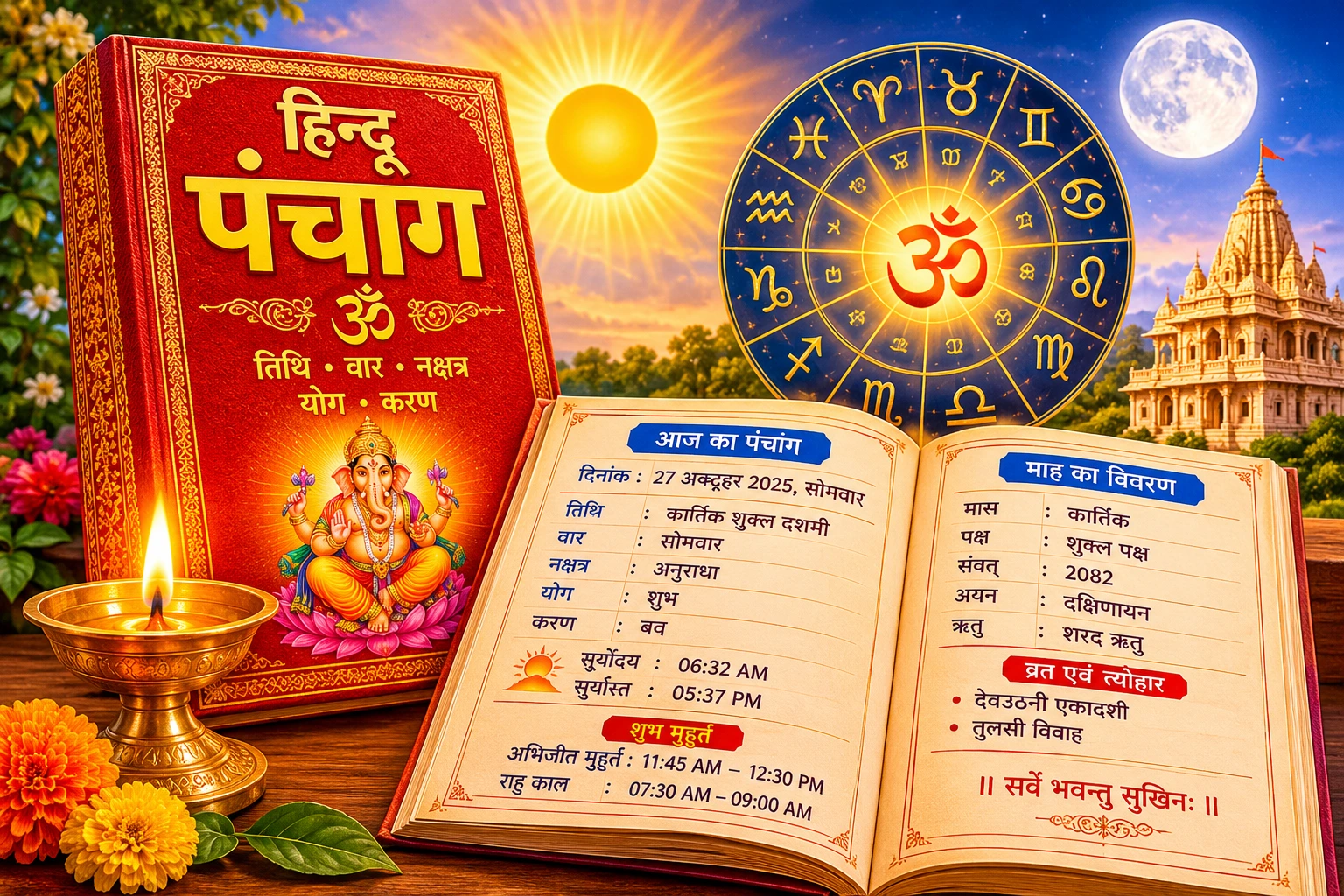
The word Panchang is formed from two Sanskrit words: Pancha, meaning five, and Anga, meaning limbs or parts. Thus, Panchang refers to a traditional calendar based on five important elements: Tithi, Vara, Nakshatra, Yoga and Karana.
Unlike an ordinary calendar that mainly displays dates and months, the Indian Panchang provides information about lunar days, planetary positions, sunrise, sunset, festivals, fasting days and auspicious timings.
Panchang is not merely a calendar; it represents the traditional Indian understanding of time, astronomy, nature and religious life.
1. What Is Indian Panchang?
Indian Panchang is a traditional Hindu lunisolar calendar used to calculate important dates and timings according to the movements of the Sun and Moon.
The Panchang provides information about the Hindu lunar months, Paksha, Tithi, Nakshatra, Yoga and Karana. It also identifies important religious occasions such as Ekadashi, Purnima, Amavasya, Pradosh Vrat, Sankranti and various Hindu festivals.
Different regions of India follow different calendar traditions, including Amanta and Purnimanta systems. Regional practices and festival dates may therefore vary.
Indian Panchang calculations also depend on geographical location because sunrise, sunset and certain religious timings change from one place to another.
2. The Five Important Elements of Panchang
The five elements form the foundation of the Hindu Panchang.
A. Tithi – The Lunar Day
Tithi is determined by the angular distance between the Sun and the Moon. A lunar month contains 30 Tithis, divided into two Pakshas.
- Shukla Paksha: The waxing phase of the Moon, from Amavasya towards Purnima.
- Krishna Paksha: The waning phase of the Moon, from Purnima towards Amavasya.
Tithis help determine important religious occasions, including Ekadashi, Chaturthi, Ashtami, Purnima and Amavasya.
B. Vara – The Day of the Week
Vara refers to the seven days of the week:
Sunday, Monday, Tuesday, Wednesday, Thursday, Friday and Saturday.
In Hindu traditions, different days are associated with particular deities and devotional practices. For example, Monday is commonly associated with Lord Shiva, Tuesday with Hanuman Ji and Thursday with Lord Vishnu and Brihaspati.
Devotees often observe fasts and perform special prayers according to these traditional associations.
C. Nakshatra – The Lunar Constellation
Nakshatra refers to one of the 27 divisions of the zodiacal path of the Moon used in traditional Indian astrology.
The Moon moves through these Nakshatras during its monthly journey. Each Nakshatra has its own traditional characteristics and astrological interpretations.
Nakshatras are considered when determining traditional Muhurta for activities such as marriage ceremonies, naming ceremonies and housewarming rituals.
D. Yoga – The Combined Solar and Lunar Position
In Panchang, Yoga is calculated using the combined celestial longitudes of the Sun and Moon. There are 27 traditional Yogas.
Certain Yogas are traditionally considered favourable, while others are associated with caution in selecting auspicious timings.
E. Karana – Half of a Tithi
Karana represents half of a Tithi. There are 11 types of Karana in the traditional Panchang system.
Karana is another factor considered when calculating auspicious timings for religious ceremonies and important activities.
Together, these five elements provide a detailed traditional understanding of the day.
3. Helps in Determining Auspicious Muhurta
One of the major benefits of Panchang is its use in selecting auspicious timings, commonly known as Muhurta.
In Hindu traditions, important activities such as marriage, Griha Pravesh, business inauguration, naming ceremonies and religious rituals are often planned according to Panchang.
Muhurta calculations may consider Tithi, Nakshatra, Vara, Yoga, Karana and other astrological factors.
Many families consult Panchang or an experienced astrologer before performing significant religious ceremonies.
The belief behind this practice is that choosing a suitable time helps begin important activities with positive intentions and spiritual blessings.
4. Helps Us Celebrate Hindu Festivals
India celebrates numerous religious festivals throughout the year. Many of these festivals are determined by the Hindu lunar calendar rather than fixed Gregorian dates.
Panchang helps identify the correct Tithi and traditional observance time for festivals such as:
- Diwali – Amavasya of Kartik month.
- Holi – Purnima of Phalguna month.
- Janmashtami – Krishna Paksha Ashtami of Bhadrapada.
- Ram Navami – Shukla Paksha Navami of Chaitra.
- Maha Shivaratri – Krishna Paksha Chaturdashi of Phalguna.
- Ganesh Chaturthi – Shukla Paksha Chaturthi of Bhadrapada.
- Raksha Bandhan – Traditionally observed on Shravan Purnima.
By following Panchang, devotees can understand the religious significance and traditional timings of these celebrations.
5. Supports Fasting and Religious Observances
Fasting, or Vrat, is an important part of Hindu religious practice.
Panchang helps devotees identify important fasting days, including Ekadashi, Pradosh Vrat, Sankashti Chaturthi, Purnima and Amavasya.
It also provides information about sunrise, sunset and Parana timings, which are important for observing certain fasts.
For example, Ekadashi fasting is traditionally associated with devotion to Lord Vishnu. Devotees may observe fasting, prayer, chanting and scripture reading on this day.
Panchang makes it easier for families to follow religious traditions throughout the year.
6. Connects Human Life with Nature and Cosmic Cycles
One of the most interesting aspects of Panchang is its relationship with natural and celestial cycles.
The Hindu calendar considers the movements of the Sun and Moon to determine months, seasons and important dates.
The Sun plays a major role in determining solar months and Sankranti, while the Moon is central to calculating Tithis and Nakshatras.
Traditional Indian knowledge also connects different seasons with agriculture, food habits, festivals and religious practices.
Panchang reminds us that human life is closely connected with nature and that time is part of a larger cosmic rhythm.
7. Preserves Indian Culture and Religious Heritage through Indian Panchang
Panchang is an important part of India’s cultural identity.
For generations, families have consulted Panchang to observe festivals, conduct religious ceremonies and pass traditional knowledge to younger generations.
It also helps preserve Sanskrit terminology, traditional astronomical calculations and regional customs.
In today’s digital age, Panchang is available through mobile applications and websites, allowing people to access daily Tithi, Nakshatra, Rahu Kaal, sunrise, sunset and festival information conveniently.
This combination of traditional knowledge and modern technology helps keep India’s heritage alive.
8. Why Should We Read Indian Panchang Every Day?
Reading the daily Panchang can become a meaningful spiritual habit.
It helps us become aware of the day’s Tithi, Nakshatra, festivals and religious observances. It also encourages us to spend a few moments remembering God and reflecting on our duties.
Many people begin their day by checking the Panchang, offering prayers to the Sun and planning their religious activities.
However, Panchang should be understood as a traditional calendar and astrological guide, not as a scientific guarantee of success or failure in everyday activities.
Our actions, discipline, knowledge and good intentions remain essential in shaping our lives.
Conclusion
The Indian Panchang is much more than a traditional Hindu calendar. It is a valuable representation of India’s ancient knowledge of astronomy, timekeeping, spirituality and cultural traditions.
Its five elements—Tithi, Vara, Nakshatra, Yoga and Karana—help devotees understand religious dates, festivals, fasting days and auspicious timings.
It connects our daily lives with the movements of celestial bodies and reminds us of the importance of living in harmony with nature.
Whether we use Panchang for religious ceremonies, festival celebrations or daily spiritual awareness, it remains an important part of Hindu life.
In a rapidly changing world, understanding our traditional knowledge helps us remain connected with our cultural roots.
Let us respect our traditions, understand the wisdom of our ancestors and begin each day with faith, positive thoughts and good actions.
ॐ तत्सत्। जय श्री हरि!