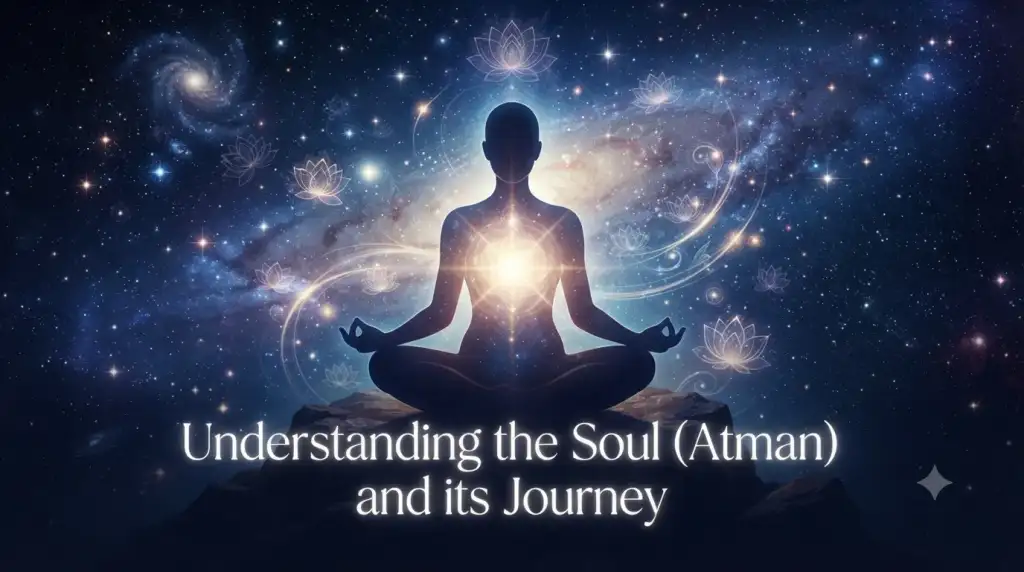
Understanding the Soul (Atman) and Its Journey According to the Upanishads
Have you ever sat quietly, looked at your hands, and wondered: Who am I really?
Table of Contents
When we look in the mirror, we see a body. We know our name, our job, our age, and our history. We know when we feel happy, sad, excited, or tired. But if you strip away your job title, your memories, your thoughts, and even your physical body, what remains?
Thousands of years ago, ancient Indian sages sat in quiet forests asking this exact question. Their deep meditations and discoveries were recorded in sacred texts called the Upanishads. The Upanishads are the core philosophical books of Vedantic wisdom. They do not ask you to blindly accept dogmas; instead, they invite you to look inside and discover the ultimate truth about yourself.
The most profound secret the Upanishads reveal is the concept of the Atman—the true, eternal Soul—and its magnificent journey through life, death, and liberation.
What is the Atman?
To understand the Upanishads, we must first understand what the Atman is and what it is not.
In simple terms, Atman is the divine spark of pure consciousness residing within every living being. It is your true Self.
Most of the time, we mistake our body and mind for who we are. The Upanishads explain this misunderstanding through a simple distinction:
- The Body and Mind: Your body grows, gets tired, ages, and eventually dies. Your mind is constantly changing—one moment you feel joyful, the next you feel stressed. Your thoughts come and go like clouds in the sky.
- The Atman: The Atman is the silent observer behind all these changes. It is the awareness that watches your thoughts, feels your emotions, and experiences life through your body. The Atman never changes. It was never born, it never ages, and it never dies.
The Katha Upanishad describes the Atman with a beautiful image: Imagine a horse-drawn chariot.
- The chariot is the physical body.
- The horses are your five senses pulling you in different directions.
- The reins are your mind.
- The driver holding the reins is your intellect or wisdom.
- The passenger sitting silently in the back, enjoying the ride, is the Atman.
You are not the chariot or the wild horses. You are the peaceful passenger inside.
Atman and Brahman: The Great Oneness
One of the most life-changing teachings of the Upanishads is that your individual soul is not isolated from the rest of the universe.
The Upanishads talk about Brahman, which means the supreme, infinite, all-pervading energy or consciousness that created and sustains everything in existence.
Here is the grand revelation: Atman and Brahman are one and the same.
To understand this simple yet deep idea, think of the ocean and a single drop of water.
- If you take a drop of water from the ocean, it seems small and separate.
- But if you analyze its essence, it has the exact same chemical nature as the vast ocean.
- When the drop falls back into the sea, it loses its separate identity and becomes the ocean itself.
Your Atman is that drop of divine consciousness, and Brahman is the infinite ocean.
In the Chandogya Upanishad, a wise teacher named Uddalaka teaches his son Svetaketu about this truth. After giving him various examples—like salt dissolving in water so that every sip tastes of salt—he gives his son the famous phrase: “Tat Tvam Asi”, which translates to “That Thou Art” (You are That divine reality).
Why Don’t We Feel Like Divine Souls?
If our soul is pure, immortal, and connected to the supreme universe, why do we suffer? Why do we feel anxious, lonely, or afraid of death?
The Upanishads explain that we suffer because of Maya (illusion) and Avidya (ignorance).
Because of ignorance, we mistakenly identify ourselves only with the outer shell—our physical body and ego. We think, “I am short,” “I am poor,” “I am failure,” or “I am getting old.” This identification builds an ego (Ahamkara), creating a wall of separateness between us and others.
When we feel separate from everything else, fear takes over. We fear losing things, we feel envy, and we fear death. The Upanishads remind us that fear only exists when we see a second thing—when we see division instead of oneness. When you realize that the same divine soul shines in everyone and everything, fear naturally vanishes.
The Journey of the Soul: Karma and Reincarnation
The Upanishads view life not as a single performance where you get one chance, but as an ongoing spiritual school. The Atman takes on physical bodies again and again to learn, experience, and mature. This journey is guided by two natural laws:
1. The Law of Karma
Karma simply means action and reaction. Every thought, word, and deed creates an impression and a consequence.
If you plant mango seeds, you will harvest sweet mangoes. If you plant thorns, you get thorns. Good actions born of kindness, honesty, and love uplift the soul and bring positive experiences. Actions driven by greed, hatred, and self-centeredness create suffering and bind the soul further into confusion.
2. Samsara (The Cycle of Rebirth)
As long as the soul has unfulfilled desires and unresolved karma, it continues in Samsara—the continuous wheel of birth, life, death, and rebirth.
When the physical body dies, the physical frame decomposes. But the Atman, carrying its subtle bundle of mind, memories, desires, and karmic tendencies, leaves the body behind. Just as a person takes off worn-out clothes and puts on fresh ones, the soul steps out of an old body and assumes a new one suitable for its next stage of learning.
The Ultimate Goal: Moksha (Liberation)
The journey of the soul through Samsara is not an endless punishment. It is an evolution toward ultimate freedom, known as Moksha.
Moksha means breaking free from the cycle of birth and death. It happens when the soul fully awakens from the dream of separateness. When a seeker realizes, not just intellectually, but deep in their core: “I am not this fragile body. I am not this anxious mind. I am the eternal Atman, one with Brahman.”
When this realization dawns:
- Desires rooted in selfishness fade away because you already feel complete.
- The storehouse of binding karma dissolves.
- Fear of death vanishes forever.
The soul reaches a state of unbroken peace, supreme joy (Ananda), and absolute freedom. It drops its temporary mortal identity and merges back into the infinite source, like a river flowing into the boundless sea.
Practical Lessons for Daily Life
The teachings of the Upanishads are not just abstract ideas for scholars sitting on mountaintops. They offer practical wisdom to transform how we live every day:
- Observe Your Thoughts: Practice stepping back from your daily drama. When anger or worry arises, remind yourself: “I am the awareness watching this emotion, not the emotion itself.” This creates instant inner space and peace.
- Treat Everyone with Kindness: When you realize that the same Atman resides in your family, your neighbors, strangers, and even animals, compassion becomes natural. Harming another person feels like harming yourself.
- Do Good Without Greed: Live life fully, work hard, and care for others, but let go of intense attachment to specific results. Trust the natural flow of Karma.
- Remember Your True Worth: When life gets tough and failure knocks on your door, remember your core identity. Your job, bank balance, or social status do not define your real value. Your true nature is pure, untainted light.
Conclusion
The Upanishads give us a message of hope and strength. They remind us that we are not weak, helpless creatures trapped in a temporary life. Beneath our daily struggles and changing emotions lies the Atman—ever-pure, ever-wise, and immortal.
The journey of the soul is a passage from ignorance to wisdom, from darkness to light, and from fear of death to the joy of eternal life. By turning our gaze inward through quiet reflection, self-inquiry, and compassionate living, we can awaken to our divine nature and experience the true beauty of existence right here, right now.