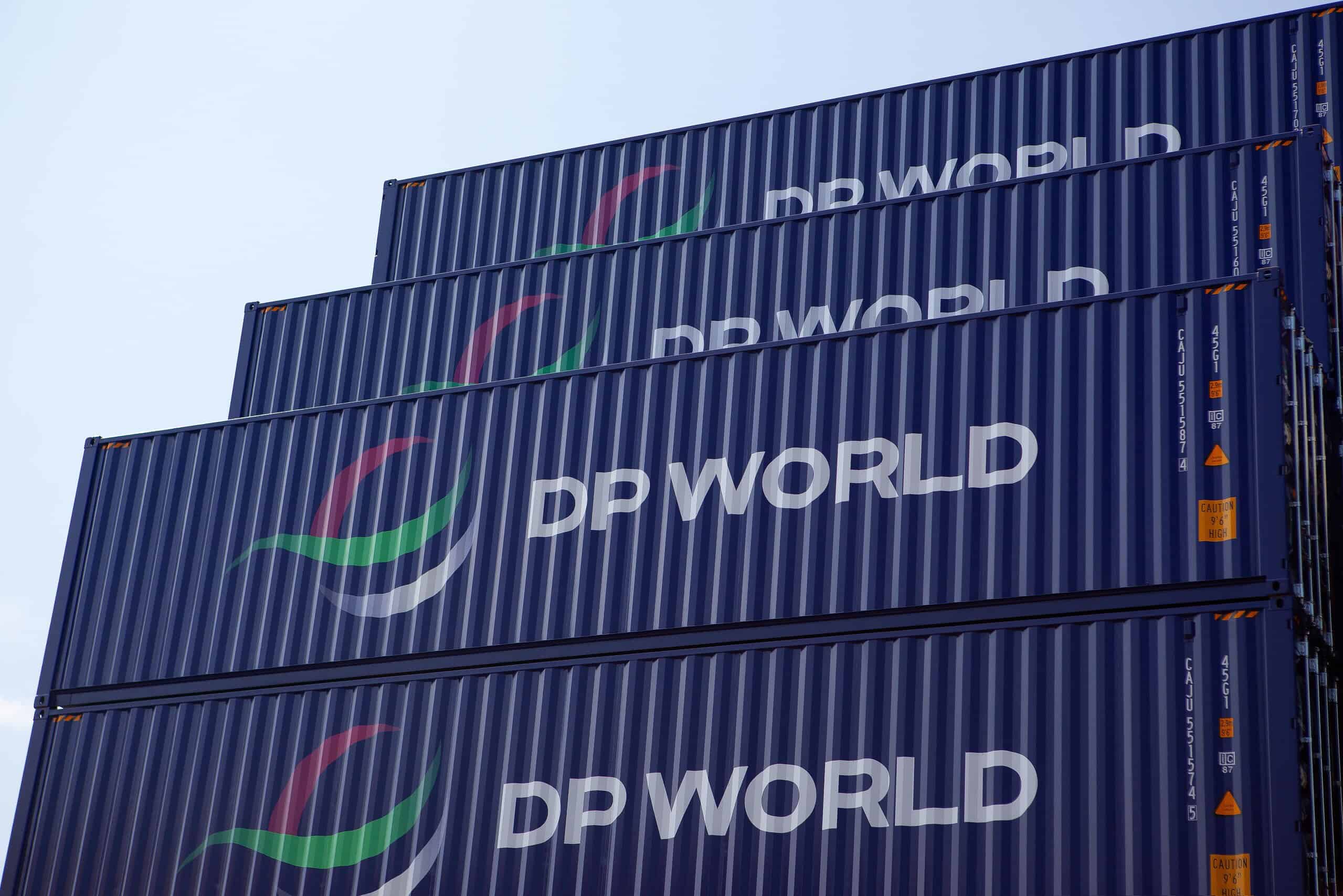
Case of financing the trade through DP World – a company that also carries cargo.
Since joining DP World in 2021, Sinan Ozcan has built a trade finance business from scratch within one of the world’s largest end-to-end logistics providers – a company that has grown from 56,000 in that time to more than 120,000 employees.
By embedding finance directly into the flow of goods, DP World can verify cargo in real time, detect fraud, and provide capital to customers that traditional banks routinely ignore.
In this interview, Ozcan, Senior Executive Officer and Board Director of DP World Trade Finance, explains how this model works – and where it is going next.
Global Finance: How have recent events in the MENA region affected your operations?
sinan ozcan: Our global network and integrated end-to-end logistics model continues to provide flexibility and resiliency across the region. Ports are operational and we have significantly increased our inland logistics capabilities. We provide bonded corridors, 24/7 tracking from ports to inland locations, and we give priority to essential cargo. Trade finance is an integral part of our global strategy to provide our customers with one-stop solutions to handle trade. DP World Trade Finance continues to support existing and new clients. We are fully active in our loan business.
GF: What lessons have been learned from this crisis in the Gulf?
ozcan:This really confirmed the validity of our strategy. Several years ago, our customers were primarily shipping lines, and our revenue came almost exclusively from port business. We realized that incorporating trade finance into cargo movement was difficult for traditional banks to understand, but for us it was a huge opportunity. Today, we have gone far beyond shipping lines, meaning we deal with warehousing, forwarding and shipping from the factory floor to the customer’s doorstep. DP World basically handles the trade from start to end and finds the route that best suits the customer. We are fast, furious and agile.
GF: What was the original idea behind DP World Trade Finance and how did it evolve?
ozcan: About 10 years ago, when DP World began its transformation journey, it was clear to us that global supply chains were quite fragile and this was having an impact on the overall business. When I joined in 2021 to set up the trade finance business, DP World had 56,000 employees; Today, we have more than 120,000.
This is a massive change that is happening all over the world. Over the past two and a half years, we have acquired several companies and opened more than 200 logistics and forwarding offices around the world.
That change required understanding the end customers: the companies that actually manufacture, trade, retail and wholesale the cargo, what we call cargo owners. So first, as your customer base changes from shipping lines to cargo owners, it requires a lot of agility from the factory floor to the customer’s door.
But even that wasn’t enough, because when we asked our customers, how can we help you more? They cited infrastructure and access to finance as their main challenges. That’s how we decided to start our own trade finance business. We wanted to do it differently: by understanding where the gaps lie, creating solutions, and making trade finance more inclusive and transparent.
GF: What is underestimated risk and how do you figure it out?
ozcan: The traditional banking method is to look at the balance sheet, but we believe a much bigger risk in business is fraud and collusion. Banks do not have full visibility into what is happening in the trade route. For example, you have a buyer and a seller, but do they actually exchange goods? Do they actually trade or collude? This is a big risk. To minimize risk, we integrate trade finance into logistics and supply chain. We link the flow of money to the flow of goods as much as possible.
If you are a bank today, you will receive a bill of lading – a transportation document – which should serve as evidence of the trade you are financing. But it can be fake, fake, lost, you name it. This creates a lot of uncertainty.
As a global logistics provider, we have visibility of over 90% of global container movements in real time. When we receive the bill of lading, whether we are handling the goods or not, we can verify that the goods exist and track them. This gives us a comprehensive view and transparency to reduce the risk of fraud and collusion.
GF: How do you then de-risk trade finance?
ozcan: There is also a misconception about trade finance as a risky asset class. This is because traditional banking methods are not able to separate the good from the bad, and they impose heavy collateral across the board. But a company can’t have unlimited collateral if it wants to keep growing. To this end, we have created a bundled trade finance solution that lets us control the cargo, collateralize it and, instead of seeking mortgage on fixed assets, collateralize the trade itself.
Another way to reduce risk is to not just look at that balance sheet or profit-loss statement – which is a piece of paper, which again can be fake, forged or lost – but also to pay attention to the trading data. We can verify everything we see on a potential borrower’s balance sheet. We can also establish patterns in the trade, which helps us significantly reduce risks.
GF: How do you see global trade changing?
ozcan: I believe that business is like a living creature that wants to be free, so no matter what happens it will find a way, because people will always need things. But in recent years, there has certainly been more protectionism, more regionalization and changes in supply chains. We also see that offshoring is gradually being replaced by nearshoring or friendshoring. There has been an overall shift towards diversification of procurement and manufacturing sources.
GF: Which trade finance products have the best growth opportunities?
ozcan: There are a lot of trade finance products, but if you talk to a customer’s CFO, it only helps them if you actually solve their problems. At DP World, we strive to provide tailored solutions: this could be a variation of an existing product, such as invoice discounting; A combination of pre-shipment inventory finance and post-shipment receivables finance; Or a permutation or combination of them.
For example, you might have a customer in the United Arab Emirates (UAE) who has very good banking, and you might think they wouldn’t need finance, but in reality not everyone will need finance. Want to grow business.
Maybe the client wants to set up an overseas office. If it chooses to set up in the US, local banks in North America will not recognize the company’s strength in the UAE and will not treat it like any other North American startup. Banks in the UAE will not have visibility into the operations and supply chain of a customer’s North American subsidiary and will be reluctant to finance it.
In this model, our ability to view their cargo movements globally allows financing for the parent company in the UAE as well as their North American subsidiary. What we are doing looks very different from a traditional bank. We offer standard products, but ultimately, we try to find solutions to bigger problems rather than being just another bank.
GF: How do you see DP World Trade Finance evolving?
ozcan: I think what we have done so far is remarkable, but I hope what we do in the next five years will be transformational. Geographic expansion is in the pipeline. We are setting up in the UK, Australia, Hong Kong, Latin America and, hopefully, North America.
We also plan to build more embedded trade finance solutions with different trade and transportation scenarios. This will be a simple yet very structured tool to help our customers get their goods to their destination faster and more cost effectively. And last but not least, we will continue to expand our cooperation with other financial institutions.
Our plan is not to become another major bank; It was never limited to just lending money. Rather, it is about supporting global trade and providing access to the lifeblood of trade: capital. And for this, we will continue to collaborate with other banks, financial institutions, trade finance funds and non-bank finance companies. We will enter into more risk participation agreements on a funded and non-funded basis, and we will add more originations to distribution.