Jio Platforms Ltd (JPL), India’s largest telecom operator and the Reliance Industries-controlled company with a growing portfolio of digital businesses, on Friday filed its draft red herring prospectus (DRHP), in what could become India’s biggest public offering ever. According to people familiar with the matter, the company could raise about ₹37,700 crore through the listing, valuing the business at about ₹9.5 trillion. The filing comes as Jio Platforms is preparing for its next growth phase, which includes plans for a sovereign low-Earth-orbit (LEO) satellite constellation and AI-native services embedded directly into its network.
DRHP is set to lead the first public listing of a consumer-facing Reliance business. This comes a decade after the launch of Reliance Jio in 2016, which reshaped India’s telecom industry through free voice services and low-cost mobile data. This will be RIL’s second IPO in recent years. It spun off its erstwhile subsidiary Jio Finance into a separate entity and listed it on the BSE in August 2023.
According to the DRHP, the IPO will consist of a fresh issue of 270 million shares with a face value of ₹10 each. The final issue price will be determined through a book-building process as per Securities and Exchange Board of India (SEBI) regulations. The issue represents about 2.9 percent of the post-issue share capital, people familiar with the matter said.
According to industry insiders, at an implied valuation of about ₹9.5 trillion (over $100 billion), the offering will surpass the size of the proposed public offering of the National Stock Exchange, which filed its own DRHP earlier this week and is expected to raise about ₹30,000 crore.
Jio Platforms reported revenue of ₹1.47 trillion and profit after tax of about ₹30,000 crore in FY26.
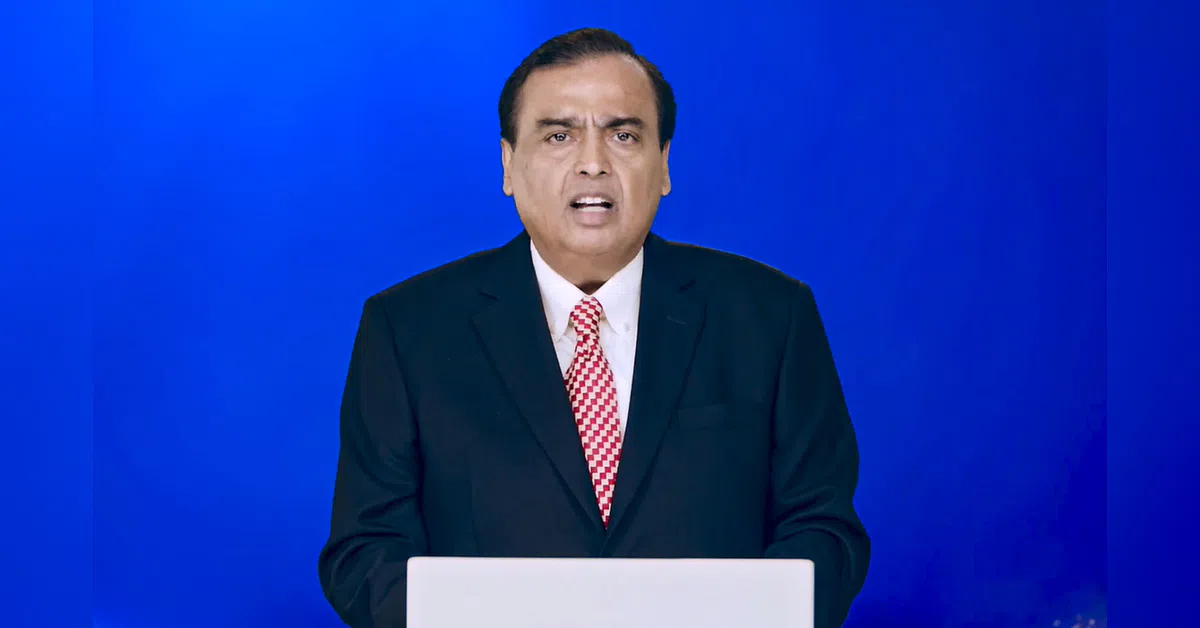
“This is an extremely emotional moment for me, the entire Reliance family and its millions of shareholders,” Reliance Industries Chairman Mukesh Ambani, 69, told shareholders at the company’s 49th annual general meeting on Friday. He described the Jio Platforms IPO as the group’s “most significant value-creating milestone this year”.
“I assure you that this will unlock great value for Reliance’s shareholders and provide attractive investment opportunities to others,” Ambani said. He said the IPO process is being led by his children Akash, Isha and Anant Ambani, who will drive the next phase of Jio’s growth.
“Jio’s proposed listing will show the world that India can create technology companies of global scale, global capability and global value,” he said. “I assure you and all potential new investors that a bright future awaits Jio.”
The IPO will not include an offer-for-sale component by existing investors including Meta, Google, KKR, Silver Lake and General Atlantic, which collectively invested about $20 billion in Jio Platforms in 2020. These investors hold 30.89 percent stake in the company, with Meta and Google holding 9.98 percent and 7.73 percent respectively. Reliance Industries’ stake is 66.43 percent.
According to the DRHP, around ₹27,500 crore from the offering proceeds will be used to prepay borrowings raised by a material subsidiary. Morgan Stanley and Kotak Mahindra Capital have been appointed lead bookrunners, along with about a dozen other banks working on the transaction.
The listing is one of the most closely watched capital-markets events in India’s corporate history and comes as Jio seeks to cash in on investor interest in telecom, digital infrastructure and technology platforms. Over the past decade, the company has expanded beyond mobile connectivity to broadband, cloud computing, enterprise services, and artificial intelligence.
“The Jio Platforms IPO is arguably the most anticipated listing in India’s telecom and digital infrastructure landscape. It represents the monetization of a diversified digital platform spanning mobility, broadband, enterprise and digital services. Investor appetite will largely depend on Jio’s ability to demonstrate sustained growth beyond traditional connectivity revenues,” said a senior executive at a global advisory firm, requesting anonymity.
According to the DRHP, up to 50 per cent of the net issue has been reserved for qualified institutional buyers, of which 60 per cent can be allocated to anchor investors and book running lead managers. A portion of this anchor allocation is reserved for domestic mutual funds, insurance companies and pension funds. About 35 per cent of the net issue is reserved for retail investors, and another minimum 15 per cent is allocated to non-institutional investors (NIIs), which include high-net-worth individuals and larger application sizes. The issue consists of specific reservations for eligible employees of the company and eligible shareholders of Reliance Industries, which will be carved out of the total issue size before the remaining shares are offered to the public.
Satcom ambitions and native AI
Jio Platforms Managing Director Akash Ambani said the company plans to build an indigenous communications satellite constellation in low-Earth orbit (LEO), while leasing capacity from leading global satellite operators to accelerate broadband coverage in deprived areas.
Akash Ambani said, “Jio connected India on the ground. Now, we have to connect India in the sky.” “There are still remote villages, island communities and border posts where the Jio network cannot reach. For them, satellite connectivity will be the bridge to the rest of India.”
He said Jio is evaluating the development of a sovereign LEO constellation while partnering with global satellite providers, a dual-track strategy aimed at expanding coverage immediately while building long-term domestic capabilities.
Akash Ambani said, “This dual approach will enable Jio to rapidly meet India’s connectivity needs while laying the foundation for a global-scale Indian satellite broadband platform.”
The company is also building ground-station infrastructure across India that will support both partner constellations and future Jio satellites, creating what it describes as an end-to-end satellite broadband ecosystem spanning space and terrestrial networks.
According to New Street Research, Jio’s satellite ambitions have increased competition in the LEO market, significantly reducing India’s revenue prospects for Starlink. “For those who have been following India for a long time, and are looking for an analogy, we are probably around 2012 when Reliance Industries was considering entry into mobile. By 2017, Jio was the market leader,” the research firm said.
Reliance also used the AGM to increase its contribution to artificial intelligence. Akash Ambani said Jio will introduce an AI agent embedded directly into the network later this year, eliminating the need for customers to download separate applications.
“Every day, Jio delivers 20 billion minutes of voice traffic, making us one of the largest voice carriers in the world,” he said. “We’re putting AI right at the heart of the Jio network. No apps to download. No numbers to add. Available to every Jio customer. In every Indian language.”
The DRHP also outlined potential global opportunities for Jio, including a $145 billion market for fixed wireless access (FWA), a $70 billion opportunity for global 5G rollout, where Jio’s own tech stack can be deployed, and $15 billion from approximately 729 million 2G handset users, where its JioBharat OS can be used to convert users to 4G or 5G.
next priorities
Akash Ambani outlined five strategic priorities for the next phase of Jio’s growth, starting with accelerating 5G adoption across its entire customer base of 524 million users by 2030. The company had 268.5 million 5G customers as of March 31, 2026.
Jio Platforms also plans to expand broadband reach through its fixed wireless access service JioAirFiber. More than 90 percent of installations are completed within 24 hours, while Home Broadband Edition is running at 60,000 connections per day.
The company will continue to digitize small and medium-sized businesses through products such as JioPC, a cloud-computing service delivered through set-top boxes, while expanding the use of artificial intelligence in network operations, customer support and consumer applications.
Jio also plans to commercialize its proprietary technology platforms internationally, leveraging software and infrastructure developed for India’s 5G, fixed wireless and AI markets. Ambani said the company expects higher average revenue per user as it expands premium 5G services, AI-enabled offerings and enterprise solutions.
Major risks mentioned in DRHP
JPL identified operational, regulatory and technology risks, primarily securing future spectrum allocation and renewing telecom licenses by Reliance Jio, and the impact of regulations governing telecom, data privacy and artificial intelligence (AI). It also mentions risks arising from possible network outages, cyber security incidents and debt obligations. Jio’s spectrum renewal is to take place between 2041 and 2042, for which it will have to participate in the auction. “Inability to retain or renew such licenses or to bid successfully for any spectrum required for our operations could have a material adverse effect on our business, financial condition and results of operations,” the DRHP said.
It also said that any measure that limits the use of social media, including by children, could reduce data consumption and adversely impact its business. “Further, any regulatory developments that restrict or limit the use of social media, including by minors or involving the online gaming industry or impose additional charges on data usage, could impact data consumption by customers, which could result in an adverse impact on our business, financial condition and results of operations,” it said.
“We may be subject to additional regulations regarding net neutrality, which could adversely affect our business, financial condition and results of operations,” DRHP said. Regulatory, legislative or self-regulatory/standard developments with respect to privacy and data security matters may also adversely affect the ability to conduct business, reputation and financial condition.
It added that regulatory authorities have from time to time considered proposals to bring over-the-counter services under a licensing or regulatory framework, and added that “any such regulation, depending on its scope and application, could alter competitive dynamics in the digital services market, impose additional compliance obligations, or alter the regulatory treatment of services provided by us and our competitors”.
On satellite constellation-based connectivity solutions, Jio said it could not assure timely deployment of its services.