Divine Lifestyle
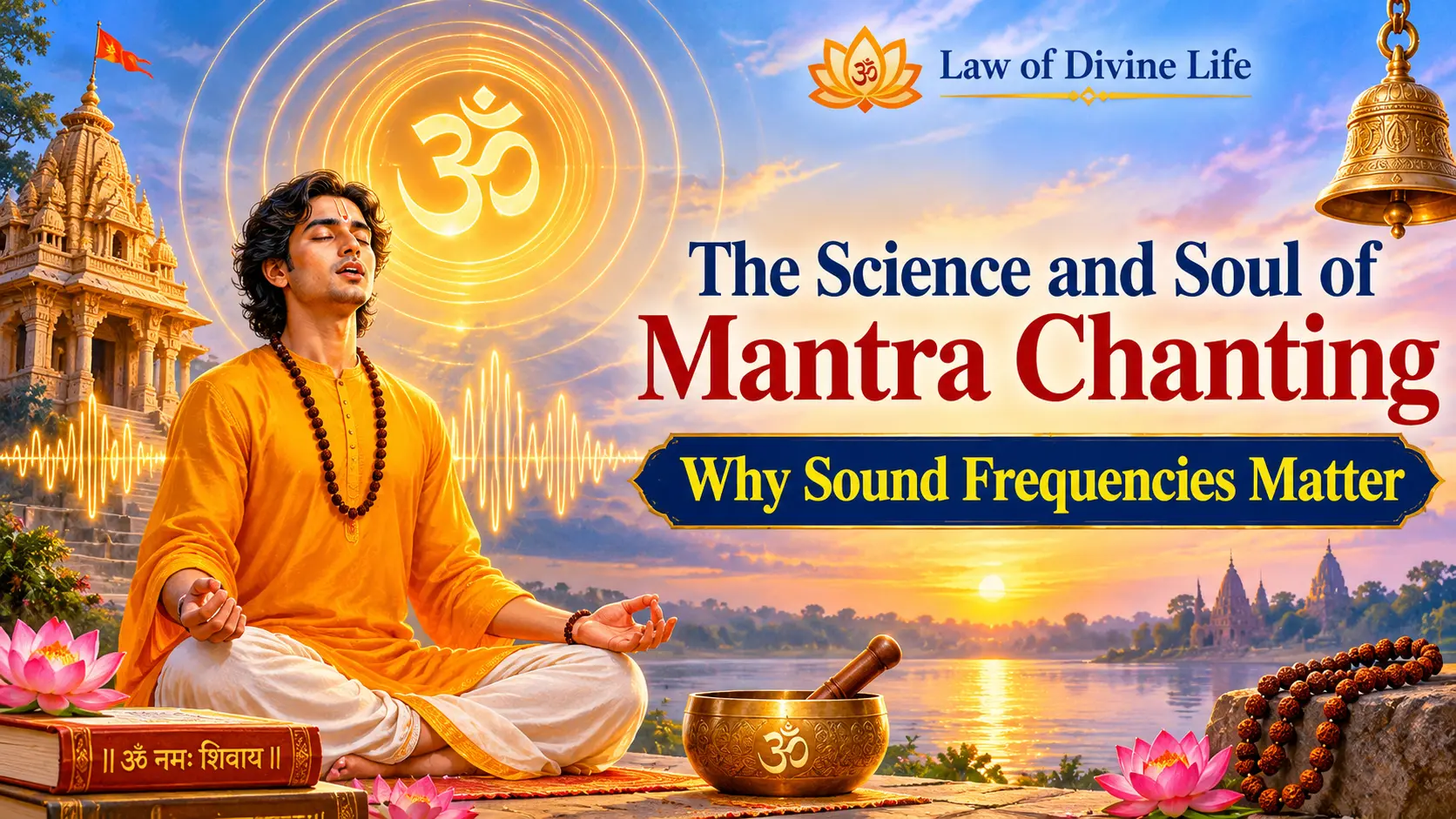
The Science and Soul of Mantra Chanting: Why Sound Frequencies Matter
Table of Contents
Introduction: The Hidden Power of Sacred Sound
Have you ever noticed how listening to a particular song can instantly change your mood? A gentle melody can calm an anxious mind, a powerful rhythm can energise the body, and a familiar voice can bring back memories that seemed forgotten.
Sound has a remarkable influence on human experience. It can affect our emotions, attention, breathing patterns, and perception of the world around us.
Ancient Indian spiritual traditions understood this relationship between sound and consciousness long before modern neuroscience began investigating it. The Vedic tradition places tremendous importance on Mantra, Nada (sound), and Shabda (sacred vibration).
Mantra chanting is not simply the repetition of religious words. It is a disciplined practice involving sound, breath, concentration, intention, and devotion.
But why do mantras matter? What happens inside the brain and body when we chant? Are particular sound frequencies responsible for spiritual experiences? And how does ancient Indian wisdom connect with modern science?
Let’s explore the science and soul of mantra chanting.

1. Understanding the Meaning of Mantra
The Sanskrit word Mantra is traditionally understood through two elements: Man, associated with the mind, and Tra, associated with protection or liberation.
A mantra is therefore commonly understood as a sacred expression that helps discipline, focus, and elevate the mind.
In Hindu traditions, mantras are used in meditation, worship, prayer, spiritual ceremonies, and personal reflection.
Some well-known examples include:
- Om (Aum): Considered a sacred primordial sound in Hindu philosophy.
- Gayatri Mantra: A Vedic prayer seeking illumination of the intellect.
- Maha Mrityunjaya Mantra: A sacred invocation associated with Lord Shiva.
- Hare Krishna Mahamantra: A devotional chant expressing surrender and love for Lord Krishna.
- Om Namah Shivaya: A revered mantra expressing devotion to Lord Shiva.
Each mantra has its own traditional meaning, pronunciation, rhythm, and spiritual significance.
The purpose is not merely to produce sound but to bring the mind into a state of greater awareness and devotion.
2. The Science of Sound: How Frequencies Influence Us
Sound is a mechanical wave produced by vibrations travelling through a medium such as air. When these waves reach our ears, the auditory system converts them into electrical signals that the brain processes.
Every sound has measurable characteristics, including frequency, amplitude, and duration.
Frequency is measured in Hertz (Hz) and describes the number of cycles of a sound wave per second. A higher frequency generally produces a higher perceived pitch, while a lower frequency produces a lower pitch.
For example, the deep resonance of a traditional temple bell feels different from the high-pitched sound of a small metallic instrument.
Sound also interacts with the physical environment through resonance. When an object is exposed to sound near one of its natural frequencies, it may vibrate more strongly.
This scientific phenomenon helps explain why particular tones feel rich, deep, or resonant.
When chanting a mantra, the voice produces vibrations that travel through the surrounding air. The chanter also experiences bodily sensations associated with breathing, vocal production, and resonance.
However, it is important to understand that not every sound frequency has a proven special healing property. The effects of chanting depend on several factors, including breathing, rhythm, attention, repetition, personal meaning, and individual response.
3. Om: The Sacred Sound and Its Spiritual Significance
Among Hindu mantras, Om or Aum holds a particularly important position.
The Mandukya Upanishad explores Om as a profound symbol of consciousness and ultimate reality.
Traditionally, its three phonetic elements are understood as:
- A: Associated with the waking state of consciousness.
- U: Associated with the dream state.
- M: Associated with deep sleep.
- The silence following the sound: Symbolically associated with Turiya, the transcendent dimension of consciousness.
This interpretation gives Om a meaning beyond ordinary sound.
When a person chants Om slowly, the sound generally begins with an open vowel, transitions through a rounded vowel, and concludes with a humming nasal resonance.
The final humming portion creates a noticeable sensation of vibration around the mouth, face, and head.
From a scientific perspective, this practice combines controlled vocalisation, sustained exhalation, auditory attention, and bodily awareness.
These elements may contribute to relaxation and concentration.
From a spiritual perspective, Om represents the unity of existence and provides a focus for meditation.
4. What Happens in the Brain During Mantra Chanting?
Modern neuroscience has started investigating what happens in the brain during repetitive chanting and contemplative practices.
A 2025 systematic review titled Neural Correlates of Chanting examined 24 neuroimaging studies. It reported that chanting engages brain regions associated with attention and emotional regulation, including the prefrontal cortex, insula, and cingulate cortex.
The review also identified changes in activity within parts of the default mode network, which is associated with self-referential thinking and mind-wandering.
Some EEG studies reported increased theta activity during chanting, a pattern associated in certain contexts with relaxed and internally focused mental states.
These findings suggest that chanting may help people direct attention, regulate emotional responses, and reduce habitual mental distraction.
Consider what happens during ordinary thinking.
The mind jumps between unfinished tasks, financial worries, past experiences, and future possibilities. This constant movement can make concentration difficult.
During mantra chanting, attention repeatedly returns to a single sound or phrase.
Every time the mind wanders, the practitioner gently brings it back to the mantra.
This repeated process can function as attention training.
5. Mantra Chanting and the Nervous System
The human nervous system constantly responds to changes in the environment.
The autonomic nervous system plays an important role in regulating functions such as heart rate, breathing, and digestion.
It includes two major branches:
Sympathetic nervous system: Helps prepare the body for action and increased demands.
Parasympathetic nervous system: Supports restorative functions and recovery.
Slow, comfortable breathing can influence autonomic activity. Because chanting often involves sustained vocalisation during exhalation, it may naturally encourage a more deliberate breathing rhythm.
Researchers have investigated whether this relationship influences heart rate variability (HRV), a measure of variations in the time between heartbeats.
A 2022 study published in the International Journal of Yoga examined five minutes of Om chanting in experienced yoga practitioners and people without yoga experience. It reported changes in certain HRV measures, suggesting possible effects on autonomic regulation.
However, research is still developing, and results should not be interpreted as proof that chanting treats medical conditions.
The practical takeaway is that comfortable, rhythmic chanting may provide a useful opportunity to slow down, breathe consciously, and settle attention.
6. Why the Quality of Sound Matters
In traditional mantra practice, pronunciation, rhythm, and sound quality are considered important.
This is especially evident in Vedic chanting, where precise pronunciation and intonation have been preserved through oral teaching traditions.
Why does pronunciation matter?
First, the physical sound changes when syllables are pronounced differently. Vowel length, consonants, and nasal sounds influence the resulting acoustic pattern.
Second, correct pronunciation helps preserve the traditional structure and meaning of the mantra.
Third, a steady rhythm makes it easier to maintain attention and coordinate chanting with breathing.
For example, chanting Om with a relaxed, continuous voice creates a different experience from shouting it quickly or repeating it without awareness.
The objective is not to produce the loudest sound. It is to develop clarity, steadiness, and conscious participation.
Traditional teachers therefore emphasise learning important mantras correctly, particularly those with specific Vedic pronunciation rules.
7. Are 432 Hz, 528 Hz and Other Frequencies Special?
In recent years, the internet has popularised claims about specific sound frequencies.
Some recordings advertise 432 Hz as a natural healing frequency, while others associate 528 Hz with transformation, DNA repair, or miraculous healing.
It is essential to distinguish measurable acoustic properties from spiritual interpretations and scientific evidence.
A frequency such as 432 Hz describes a particular sound pitch. It does not automatically establish that the sound possesses a unique healing ability.
There is research investigating music, sound, meditation, and their possible effects on psychological and physiological wellbeing. However, strong scientific evidence does not currently establish that 432 Hz or 528 Hz has universal or miraculous healing properties.
The benefits people experience from mantra chanting may arise from several interacting factors:
- Repetition and focused attention.
- Slow and comfortable breathing.
- Emotional meaning and devotional connection.
- Familiarity and a sense of spiritual belonging.
- The calming experience of sustained vocalisation.
Therefore, the most meaningful approach is to focus on the mantra’s traditional significance, correct practice, and the quality of attention rather than chasing supposedly magical frequencies.
8. The Spiritual Dimension: From Sound to Silence
Science can investigate sound waves, brain activity, breathing patterns, and measurable physiological responses.
But the spiritual meaning of mantra chanting reaches beyond these measurements.
In Indian philosophy, Nada Brahma is an expression associated with the understanding of the universe through the principle of sound.
The spiritual traditions of India also describe different dimensions of sound, including Vaikhari, Madhyama, Pashyanti, and Para.
These concepts are interpreted in different ways across traditional schools, but broadly point towards increasingly subtle dimensions of expression and awareness.
The deeper purpose of mantra meditation is not simply to hear an external sound.
It is to move from external distraction towards inner awareness.
Initially, a person may chant aloud. With practice, chanting may become softer, whispered, or mental.
Eventually, the practitioner may experience periods of silence in which attention remains steady without the need for continuous verbal repetition.
This transition from sound to silence is an important theme in many contemplative traditions.
9. How to Practise Mantra Chanting Daily
You do not need expensive instruments, special equipment, or a complicated meditation room to begin.
A simple and consistent practice can be meaningful.
Step 1: Choose a mantra
Select a mantra that has spiritual significance for you. Beginners may start with Om or another familiar prayer.
Step 2: Find a quiet place
Sit comfortably with your back naturally upright. Relax your shoulders and facial muscles.
Step 3: Begin with gentle breathing
Take a few comfortable breaths. Avoid forcing or holding your breath.
Step 4: Chant slowly
Repeat your selected mantra at a comfortable volume. Pay attention to pronunciation, rhythm, and the sensation of sound.
Step 5: Observe your attention
If thoughts arise, do not become frustrated. Gently return your attention to the mantra.
Step 6: Experience silence
After chanting for five to ten minutes, remain quietly seated for a few moments. Observe your breathing and mental state.
Step 7: Practise consistently
Regular practice is generally more useful than occasional long sessions.
Remember that mantra chanting should feel comfortable. Stop or modify the practice if you experience dizziness, vocal strain, or discomfort.
10. The Deeper Message: Mantra as a Bridge Between Science and Spirituality
One of the most fascinating aspects of mantra chanting is that it brings together several dimensions of human experience.
The physical dimension involves sound waves, vocal production, and breathing.
The psychological dimension involves attention, memory, emotions, and concentration.
The spiritual dimension involves devotion, self-awareness, faith, and the search for deeper meaning.
These dimensions do not need to compete with one another.
Science can help us understand some of the physical and neurological processes associated with chanting. Spiritual philosophy can help practitioners explore its meaning and purpose.
The two approaches ask different but potentially complementary questions.
Science asks: What changes can we measure when someone chants?
Spirituality asks: What does this practice reveal about the mind, the self, and the nature of existence?
Together, they provide a richer understanding of why mantra chanting has remained meaningful across generations.
Conclusion: Discovering the Power Within Sacred Sound
Mantra chanting is much more than repeating a collection of sacred words. It is a practice that combines sound, breath, attention, discipline, and devotion.
Ancient Indian traditions recognised the importance of sound in spiritual development, while modern research is beginning to explore how chanting interacts with the brain and nervous system.
Although many popular claims about specific healing frequencies require stronger scientific evidence, research does suggest that chanting can influence attention and may support relaxation for some practitioners.
The deeper lesson is that the value of a mantra does not depend only on its acoustic frequency. Its meaning, pronunciation, rhythm, intention, and the awareness with which it is repeated are equally important.
When the mind is scattered, mantra gives it a point of focus. When emotions become restless, rhythmic chanting can create an opportunity to pause. When life becomes noisy, the practice can help us rediscover silence within.
Sound may begin the journey, but awareness gives it meaning. And in the silence that follows, we may discover a deeper connection with ourselves and the Divine.