


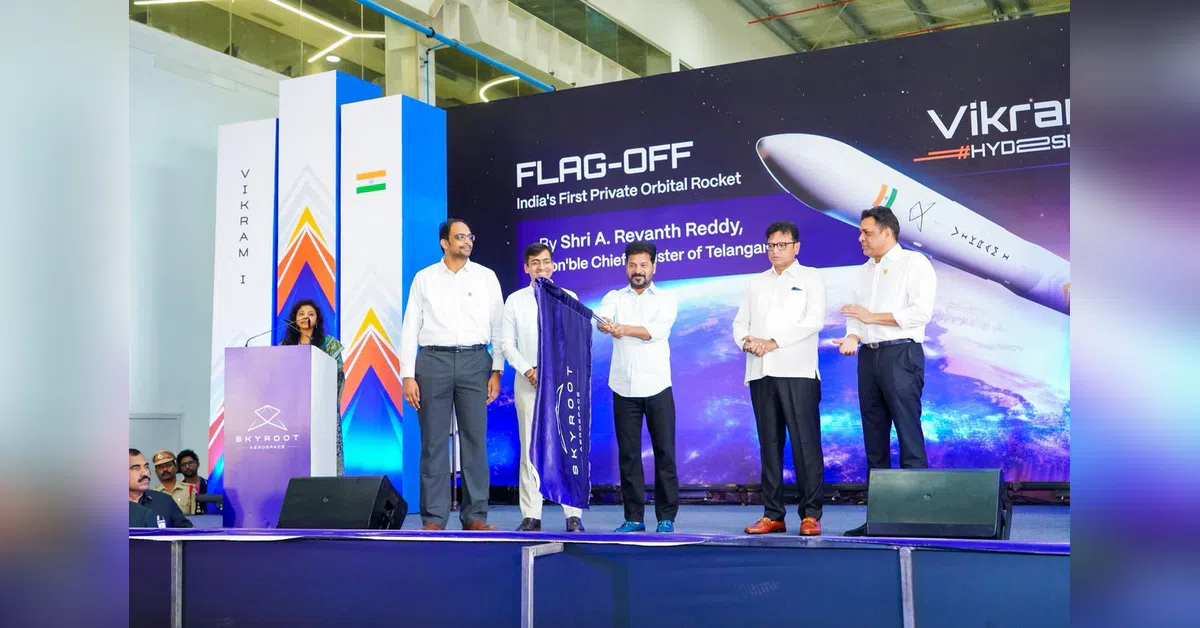
India’s private space sector is set for a major milestone as Skyroot Aerospace is set to attempt the country’s first privately developed orbital launch with Vikram-1 later this month.
The Hyderabad-based firm said on July 2 that it would attempt the launch between July 12 and August 4, depending on the completion of assembly and testing operations at the launch site at the Satish Dhawan Space Center in Sriharikota.
This mission follows the successful launch by Skyroot of Vikram-S, India’s first privately built rocket to reach suborbital space in November 2022.
However, Skyroot is not alone in the race. After India opened up the space sector to private players in 2020, a handful of startups have started developing their own launch vehicles, hoping to take advantage of the growing global demand for small satellite launches.
Defense and aerospace giants such as Larsen & Toubro (L&T) and Hindustan Aeronautics Limited (HAL) are planning beyond supplying components, announcing plans to build rockets and strengthen their presence in the country’s commercial launch ecosystem.
The move comes as India looks to grow its space economy from about $8.4 billion today to $44 billion by 2033. According to the Economic Survey 2025-26, the sector currently accounts for about 2 per cent of the global space economy, with future growth expected to be driven by launch services, satellite communications, Earth observation, navigation and an increasingly vibrant private sector.
India’s effort to open up the space sector to private companies reflects a broader global shift toward greater commercial involvement in launch services and other space activities.
Here’s a look at some of the companies building India’s next generation launch vehicles that are hoping to take advantage of the country’s growing space launch economy.
Skyroot Aerospace
Founded in 2018 by former ISRO scientists, Pawan Kumar Chandna and Naga Bharat Daka, Skyroot Aerospace became the first Indian private company to launch a rocket into space with the successful suborbital flight of Vikram-S in 2022. The company is now preparing to make history again with India’s first privately developed orbital launch vehicle Vikram-1, which is designed to place payloads of up to 350 kg into low-Earth orbit.
If successful, Vikram-1 will be India’s first privately executed orbital launch, allowing Skyroot to join a small group of companies capable of developing and operating orbital rockets globally.
Skyroot became India’s first space startup to reach a valuation of $1 billion after raising $60 million from GIC and Sherpalo Ventures.
Agnikul Universe
Chennai-based Agnikul Cosmos is developing Agnibaan, a customizable small-satellite launch vehicle capable of carrying payloads of up to 300 kg into orbit. In 2024, it successfully conducted the country’s second private rocket launch and became the first Indian startup to launch from its privately built launchpad in Sriharikota.
The company is known for its large-scale 3D-printed semi-cryogenic engines and is working towards commercial orbital launch services for small satellites. It launched the world’s first rocket with a single piece 3D printed engine, which was indigenously designed, from Sriharikota in May 2024.
Larsen and Toubro
L&T, which has long been associated with ISRO as a supplier of launch vehicle hardware, propulsion systems and ground infrastructure, is now looking to expand into rocket manufacturing with the opening up of India’s commercial space sector.
The engineering major intends to leverage decades of aerospace sector expertise to support both government and commercial launch programs, moving beyond its traditional role as a component supplier. L&T has long been involved in manufacturing key components for Indian missiles, Mars and lunar missions, satellites and artillery.
With private companies now eligible to design, build and operate launch services, companies like L&T are well positioned to benefit from the growing demand for commercial satellite launches. reuters.
Hindustan Aeronautics Limited
State-owned HAL, known for aircraft and defense manufacturing, has also announced plans to enter rocket manufacturing as it looks to diversify its space business.
HAL has long built structures and systems for ISRO missions. Its expansion in launch vehicle production signals broader pressure by public sector aerospace companies to participate in India’s emerging commercial launch market.
Along with L&T, HAL is building the Polar Satellite Launch Vehicle (PSLV), the mainstay of ISRO’s satellite launch programme, through a consortium.
Startups and established aerospace manufacturers are together transforming India’s launch ecosystem, signaling a shift from an ISRO-led model to the broader commercial space industry.